
Mecinus
Dejean, 1821
Species Guides
4- Mecinus janthinus(Toadflax stem weevil)
- Mecinus linnavuorii
- Mecinus pascuorum(plantain weevil)
- Mecinus pyraster(Stem Miner Weevil)
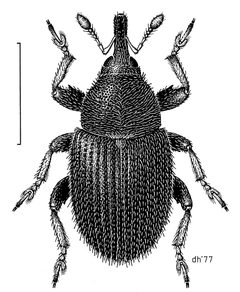
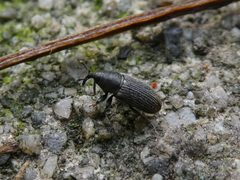
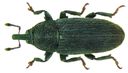
Mecinus is a of true weevils (Curculionidae) containing approximately 90 described , with 47 Palaearctic species formally revised in recent taxonomic treatments. Species are arranged into seven and two based on phylogenetic analysis of morphological characters. The genus is exclusively Palaearctic in distribution and exhibits diverse feeding strategies including seed , stem boring, and gall induction.
Pronunciation
How to pronounce Mecinus: /ˈmɛsɪnʊs/
These audio files are automatically generated. While they are not always 100% accurate, they are a good starting point.
Identification
-level identification requires examination of rostral characters, terminalia, and body proportions. The includes two (M. pascuorum and M. elongatus complexes) containing morphologically similar species that lack clear . External rostral characters can be used to differentiate sexes in at least some species. Elongate body shape characterizes a major clade including the M. collaris, M. circulatus, M. heydenii, and M. janthinus groups, with reversal to oval body shape in some M. simus group species.
Images
Distribution
Exclusively Palaearctic. Individual distributions vary; some have been introduced outside native ranges as agents.
Host Associations
- Plantaginaceae - primary All Mecinus feed on Plantaginaceae. Feeding on Plantagineae represents the plesiomorphic condition for the .
- Plantagineae - tribeAncestral plant tribe for the .
- Antirrhineae - tribeDerived association; feeding on Antirrhineae are concentrated in the M. heydenii and M. janthinus groups.
Human Relevance
Some are used as agents for weeds. Mecinus janthinus has been widely released to control Dalmatian toadflax (Linaria dalmatica) in North America and has established in western Canada and the Rocky Mountain region. M. pascuorum has been introduced to New Zealand, where it has become a post-harvest contaminant of kiwifruit despite being primarily associated with narrow leaf plantain.
Similar Taxa
- GymnetronHistorical confusion; many Mecinus were formerly described under Gymnetron, necessitating numerous new synonymies in recent revisions.
More Details
Taxonomic history
The has undergone extensive revision, with many transferred from Gymnetron and numerous synonymies established. A 2013 revision recognized 47 Palaearctic species including one new species (M. baridioides) and multiple lectotype designations.
Phylogenetic structure
Six monophyletic groups and one monobasic group are recognized, plus two (M. pascuorum and M. elongatus) that lack synapomorphies and produce polytomic topologies. plant optimization indicates independent shifts between Plantagineae and Antirrhineae feeding.
Sources and further reading
- BugGuide
- Wikipedia
- GBIF taxonomy match
- iNaturalist taxon
- NCBI Taxonomy
- Catalogue of Life
- Systematics of the weevil genus <i>Mecinus</i> Germar, 1821 (Coleoptera: Curculionidae). I. Taxonomic treatment of the species
- Overwintering mortality of and host attack by the stem-boring weevil, Mecinus janthinus Germar, on Dalmatian toadflax (Linaria dalmatica (L.) Mill.) in western Canada
- Temperature and host-plant effects on development and population growth of Mecinus janthinus (Coleoptera: Curculionidae), a biological control agent for invasive Linaria spp.
- Postrelease Evaluation of Mecinus janthinus Host Specificity, a Biological Control Agent for Invasive Toadflax (Linaria spp.)
- External rostral characters for differentiation of sexes in the biological control agent Mecinus janthinus (Coleoptera: Curculionidae)
- Systematics of the weevil genus <i>Mecinus</i> Germar, 1821 (Coleoptera: Curculionidae). II. Phylogenetic analysis based on adult morphological characters and host plant information
- Summer Development and Survivorship of the Weed Biocontrol Agent, Mecinus janthiniformis (Coleoptera: Curculionidae), Within Stems of Its Host, Dalmatian Toadflax (Lamiales: Plantaginaceae), in Utah
- Impact of <i>Mecinus Janthinus</i> (Coleoptera: Curculionidae) on the Growth and Reproduction of <i>Linaria Dalmatica</i> (Scrophulariaceae)
- Phenology and ovarian development of the introduced weevil Mecinus pascuorum , a passenger pest of kiwifruit in New Zealand