
Cleopomiarus
Pierce, W.D., 1919
Species Guides
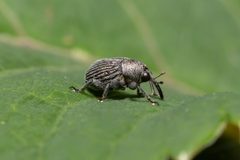
1- Cleopomiarus hispidulus(clover root curculio)
Cleopomiarus is a of weevils in the tribe Mecinini (Curculionidae), established by Pierce in 1919. The genus comprises approximately 21 Holarctic , including two North American and 19 Palaearctic species, with additional species described from China. Species are associated with Campanulaceae plants. Cleopomiarus was historically conflated with the genus Miarus but has been reinstated as distinct based on morphological characters of and stages.
Pronunciation
How to pronounce Cleopomiarus: //kliː.oʊˌpoʊ.miˈeɪ.rəs//
These audio files are automatically generated. While they are not always 100% accurate, they are a good starting point.
Identification
distinguished from related Miarus by rostral and genitalic characters. Larvae of Cleopomiarus lack the distinctive maxillary mala with six finger-like marginal setae of two sizes that characterizes Miarus larvae. Pupae differ in setal length on , rostrum, and pronotum, number of rostral setae, number of dorsal setae on pronotum, and shape of urogomphi. Detailed larval and pupal has been described for C. distinctus, C. graminis, C. longirostris, C. medius, and C. meridionalis.
Images
Distribution
Holarctic distribution: North America (2 ), Palaearctic region (19+ species). Records from Europe (including Denmark, Norway, Sweden), North Africa (Algeria, Morocco), Asia (Afghanistan, Armenia, China), and Southern Africa. Chinese fauna includes C. distinctus, C. vestitus, C. flavoscutellatus, C. graminis, and two species C. danfengensis (Shaanxi) and C. nuerhachii (Inner Mongolia).
Host Associations
- Campanulaceae - larval development in flowers-level association inferred from multiple ; C. micros develops in Jasione montana and Campanula patula flowers
Similar Taxa
- MiarusFormerly considered congeneric; distinguished by larval maxillary mala (Miarus has six finger-like marginal setae of two sizes, Cleopomiarus lacks this), pupal setal characters, and genitalic features. Both may be monophyletic based on shared distinctive characters.
More Details
Taxonomic history
Cleopomiarus was synonymized with Miarus for much of the 20th century but reinstated as valid based on phylogenetic and morphological studies. Multiple transferred between genera; extensive synonymy revised in 2016 systematic treatment.
Immature stage morphology
Larval and pupal has proven systematically valuable for distinguishing Cleopomiarus from Miarus and for -level identification within the . COI barcoding has been used to confirm larval identifications.
Sources and further reading
- BugGuide
- Wikipedia
- GBIF taxonomy match
- iNaturalist taxon
- NCBI Taxonomy
- Catalogue of Life
- Systematics of the Holarctic species of the weevil genus Cleopomiarus Pierce (Coleoptera: Curculionidae)
- A taxonomic revision of Chinese Cleopomiarus Pierce (Coleoptera: Curculionidae) with description of two new species
- The morphology of the preimaginal stages of Cleopomiarus micros (Germar, 1821) (Curculionidae, Coleoptera) and notes on its biology
- Morphological characters of immature stages of Palaearctic species of Cleopomiarus and Miarus and their systematic value in Mecinini (Coleoptera, Curculionidae, Curculioninae)
- Miarus Schoenherr and Cleopomiarus Pierce (Coleoptera: Curculionidae) Species Associated with Campanula L. (Campanulaceae) Plants in the Eastern Black Sea Region of Turkey
- Figure 9 from: Szwaj E, Łętowski J, Pawlęga K (2018) The morphology of the preimaginal stages of Cleopomiarus micros (Germar, 1821) (Curculionidae, Coleoptera) and notes on its biology. ZooKeys 798: 45-62. https://doi.org/10.3897/zookeys.798.27173
- Figure 7 from: Szwaj E, Łętowski J, Pawlęga K (2018) The morphology of the preimaginal stages of Cleopomiarus micros (Germar, 1821) (Curculionidae, Coleoptera) and notes on its biology. ZooKeys 798: 45-62. https://doi.org/10.3897/zookeys.798.27173
- Figure 5 from: Szwaj E, Łętowski J, Pawlęga K (2018) The morphology of the preimaginal stages of Cleopomiarus micros (Germar, 1821) (Curculionidae, Coleoptera) and notes on its biology. ZooKeys 798: 45-62. https://doi.org/10.3897/zookeys.798.27173
- Figure 8 from: Szwaj E, Łętowski J, Pawlęga K (2018) The morphology of the preimaginal stages of Cleopomiarus micros (Germar, 1821) (Curculionidae, Coleoptera) and notes on its biology. ZooKeys 798: 45-62. https://doi.org/10.3897/zookeys.798.27173
- Figure 1 from: Szwaj E, Łętowski J, Pawlęga K (2018) The morphology of the preimaginal stages of Cleopomiarus micros (Germar, 1821) (Curculionidae, Coleoptera) and notes on its biology. ZooKeys 798: 45-62. https://doi.org/10.3897/zookeys.798.27173
- Figure 2 from: Szwaj E, Łętowski J, Pawlęga K (2018) The morphology of the preimaginal stages of Cleopomiarus micros (Germar, 1821) (Curculionidae, Coleoptera) and notes on its biology. ZooKeys 798: 45-62. https://doi.org/10.3897/zookeys.798.27173
- Figure 4 from: Szwaj E, Łętowski J, Pawlęga K (2018) The morphology of the preimaginal stages of Cleopomiarus micros (Germar, 1821) (Curculionidae, Coleoptera) and notes on its biology. ZooKeys 798: 45-62. https://doi.org/10.3897/zookeys.798.27173
- Figure 6 from: Szwaj E, Łętowski J, Pawlęga K (2018) The morphology of the preimaginal stages of Cleopomiarus micros (Germar, 1821) (Curculionidae, Coleoptera) and notes on its biology. ZooKeys 798: 45-62. https://doi.org/10.3897/zookeys.798.27173
- Figure 3 from: Szwaj E, Łętowski J, Pawlęga K (2018) The morphology of the preimaginal stages of Cleopomiarus micros (Germar, 1821) (Curculionidae, Coleoptera) and notes on its biology. ZooKeys 798: 45-62. https://doi.org/10.3897/zookeys.798.27173