
Ellescus
Dejean, 1821
Species Guides
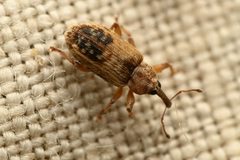
4Ellescus is a of true weevils in the Curculionidae, tribe Ellescini. The genus contains approximately 16 described globally. In North America, four valid species are recognized: the widespread and morphologically variable E. ephippiatus, the Holarctic E. bipunctatus, the west coast E. californicus, and the temperate E. michaeli. Species identification relies on morphological examination and molecular markers, particularly ITS2, which has proven more reliable than CO1 for delineating closely related species.


Pronunciation
How to pronounce Ellescus: /ˈɛl.lɛs.kəs/
These audio files are automatically generated. While they are not always 100% accurate, they are a good starting point.
Identification
Identification of Ellescus requires careful morphological examination due to intraspecific variability, particularly in E. ephippiatus. In North America, an illustrated identification key is available. Molecular methods are recommended for difficult specimens: ITS2 reliably separates E. ephippiatus from E. michaeli, whereas CO1 barcoding fails to distinguish these two species. E. californicus is restricted to the west coast, and E. bipunctatus has a Holarctic distribution.
Images
Distribution
The has a Holarctic distribution. In North America, four are documented: E. ephippiatus is widespread across the continent; E. bipunctatus occurs across the Holarctic; E. californicus is to the west coast; and E. michaeli has a temperate distribution. European species E. scanicus has been erroneously reported from North America. Distribution records also exist from Denmark, Norway, and Sweden.
Misconceptions
E. scanicus, a European , was previously reported from North America but has been determined to be erroneously recorded there. E. borealis has been synonymized with E. bipunctatus. E. californicus was previously treated as a synonym of E. ephippiatus but has been resurrected as a valid species based on integrative taxonomic evidence.
More Details
Taxonomic revision methodology
The North American revision of Ellescus employed integrative combining morphological and molecular techniques. sequences for CO1 and ITS2 were generated to support delineation. A neotype was designated for E. bipunctatus to stabilize .
Molecular marker utility
CO1 barcoding failed to delineate E. ephippiatus and E. michaeli, but the faster-evolving ITS2 marker reliably separated these . This finding supports the use of multiple molecular markers in weevil delineation and highlights the particular utility of ITS2 in this .