
Curculio sayi
Gyllenhal, 1836
small chestnut weevil, lesser chestnut weevil
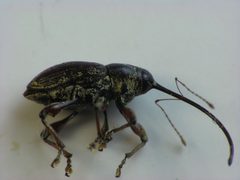
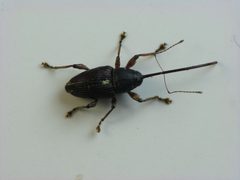
Curculio sayi is a true weevil ( Curculionidae) known as the small or lesser chestnut weevil. It is a highly -specific pest of chestnuts in the Castanea, feeding and ovipositing exclusively on chestnut and chinquapin . The species was historically a major pest of American chestnut (Castanea dentata) before the chestnut blight, with rates of 50-75% considered normal. It has resurged as a significant pest with the restoration of blight- chestnut plantings. exhibit in body size and rostrum length, with females being larger and possessing longer snouts adapted for penetrating chestnut burrs.
Pronunciation
How to pronounce Curculio sayi: /kʊrˈkuːli.oʊ ˈsei.aɪ/
These audio files are automatically generated. While they are not always 100% accurate, they are a good starting point.
Identification
Distinguished from the greater chestnut weevil (Curculio caryatrypes) by smaller size and less specificity; C. caryatrypes was reportedly more strictly host-specific to American chestnut and may now be extinct. Distinguished from other weevil by association with Castanea hosts and the characteristic long rostrum with first funicular segment longer than second. Females have noticeably longer rostrums than males. Clean chew holes on nut shells are usually too small to be visually identified unless mold develops.
Images
Habitat
Chestnut orchards, forests, and landscapes containing Castanea (chestnuts and chinquapins). occur in tree ; larvae develop within chestnuts; occurs in soil chambers 7-15 cm below the soil surface.
Distribution
North America, from Canada (Ontario, Québec) and Massachusetts south to North Carolina, Tennessee, and Ohio, with range extending westward. Documented in mid-Missouri with specific studies on seasonal occurrence and soil distribution.
Seasonality
from soil varies by locality and season, occurring from May through October with peaks varying by region. In mid-Missouri, emergence occurs May-June, stops in July, and resumes late August through October. In New York State, peak occurs in mid-October at approximately 2,500 growing degree days (DD50F). Michigan populations fluctuate biennially with higher populations in odd-numbered years. Larval emergence from fallen chestnuts peaks at six days post-harvest and declines by day 16, though some larvae may emerge more than four weeks post-harvest.
Diet
Highly -specific to Castanea. feed on chestnut tissues. Larvae feed on developing chestnut kernels; a single viable chestnut can support development of up to a dozen larvae simultaneously.
Host Associations
- Castanea dentata - American chestnut; historically major , now rare due to chestnut blight
- Castanea mollissima - Chinese chestnut; used in breeding programs for blight resistance
- Castanea hybrids - Chinese-American chestnut hybrids show differential susceptibility; F1 hybrids most susceptible, backcross hybrids remain substantially susceptible
- Castanea pumila - Chinquapin; included in range
Life Cycle
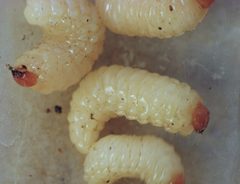
Complete with extended . emerge from soil and climb to to feed and mate. Females use elongated rostrum to chew holes in nut shells for oviposition. hatch in 5-7 days; legless white larvae feed on kernel tissue through four instars. Mature larvae chew 1/8-inch exit holes and drop to ground, often while nuts still in tree. Peak larval from fallen nuts at 6 days post-harvest. Larvae burrow 7-15 cm into soil, construct chambers, and pupate after several months (up to 18 months or longer), remaining in soil at least one season. Adults from single larval may emerge over multiple years due to facultative ; life cycle may complete in 1-4 years.
Behavior
are poor dispersers with average distance of 220 m. Females use rostrum to bypass sharp burr spines and excavate before laying, which prevents egg desiccation. Adults drop when branches are jarred (limb-tapping response). Activity likely temperature-dependent; related pecan weevils show increased flight at 27-35°C. activity patterns likely based on related .
Ecological Role
Seed specializing on Castanea . Can function as pest sink in chestnut restoration areas, particularly on susceptible hybrid . Larval feeding reduces nut germination and seedling growth. associated with Aspergillus fungi producing emodin toxin.
Human Relevance
Major pest of chestnut and restoration efforts. Historical rates of 50-75% in American chestnut crops. Resurged pest with blight- chestnut plantings. Infested nuts show reduced germination and seedling growth. Managed through orchard , chemical control of , with fungi and , and post-harvest heat treatment (20 minutes at 49°C). Scouting uses pyramid traps and limb-tapping. No registered specifically target larvae.
Similar Taxa
- Curculio caryatrypesGreater chestnut weevil; larger, more strictly -specific to American chestnut, possibly extinct due to chestnut blight
- Curculio elephasEuropean chestnut weevil; occupies similar in Europe, less -specific (also uses oak acorns), not present in North America
- Curculio glandiumAcorn weevil; similar and but specialized on oak acorns rather than chestnuts
- Conotrachelus nenupharPlum curculio; similar weevil pest of fruit crops but attacks rosaceous (stone and pome fruits) rather than chestnuts
More Details
Host Resistance and Restoration Implications
Research demonstrates that Chinese-American chestnut hybridization dramatically alters susceptibility to C. sayi. F1 hybrids are most susceptible, while American chestnuts show no larval . Backcross hybrids retain substantial susceptibility despite 3-4 of backcrossing. This creates a trade-off for chestnut restoration: blight resistance derives from Chinese , while weevil resistance appears associated with American genome. Incorporating weevil resistance screening into breeding programs is recommended to ensure restored chestnuts can fulfill historical ecological roles.
Diapause and Life Cycle Plasticity
Exhibits strategy through variable duration. Larvae may complete development in 1-4 years depending on environmental conditions. Prolonged diapause may respond to seasonal challenges such as dry summers with hardened soil, which can prevent . Similar to related European Curculio elephas where emergence from single varied: 66% first year, 30% second year, 4% third year.
Chemical Ecology
Responds behaviorally and electrophysiologically to plant volatile organic compounds from chestnut tissues. Research has investigated antennographic responses to mixtures of key host plant volatiles, indicating olfactory-mediated host location.
Sources and further reading
- BugGuide
- Wikipedia
- GBIF taxonomy match
- iNaturalist taxon
- NCBI Taxonomy
- Catalogue of Life
- That UC Davis Beetle T-Shirt: A Big Hit Across the Pond | Bug Squad
- Curculionidae | Beetles In The Bush | Page 2
- Bug Eric: Wasp Wednesday: Perilampid Wasps
- Clover Root Curculio: Historic Perspectives Guide Modern Management
- Plum Curculio: New Guide Gathers IPM Recommendations for North American Fruit Pest
- A mast year brings a bountiful harvest to acorn weevils, Curculio glandium — Bug of the Week
- The Lesser of Two Weevils: Differential Susceptibility of Chinese–American Chestnut Hybrids to Curculio sayi
- The seasonal occurrence, soil distribution and flight characteristics of Curculio sayi (Coleoptera : Curculionidae) in mid-Missouri
- Seasonal Occurrence and Soil Distribution of the Lesser Chestnut Weevil, Curculio sayi (Coleoptera: Curculionidae) in Mid-Missouri
- The Lesser Chestnut Weevil (Curculio sayi): Damage and Management with Biological Control Using Entomopathogenic Fungi and Entomopathogenic Nematodes
- The chemical ecology of the lesser chestnut weevil : behavioral and electrophysiological responses of Curculio sayi (Coleoptera : curculionidae) to host-plant volatile organic compounds
- Behavioral and Electroantennographic Responses of the Lesser Chestnut Weevil, Curculio sayi (Coleoptera: Curculionidae), to Odors Emanating from Different Chestnut Plant Tissues
- Electroantennographic and Behavioral Responses of the Lesser Chestnut Weevil,Curculio sayi(Coleoptera: Curculionidae), to Mixtures of Selected Key Host Plant Volatiles
- Phenology and Monitoring of the Lesser Chestnut Weevil (Curculio sayi).