
Odontopus calceatus
Say, 1831
Yellow Poplar Weevil, Sassafras Mining Weevil, Tuliptree Leafminer, Tulip Tree Weevil, Magnolia Leaf Miner
A small weevil in the Curculionidae, known for feeding on and mining the leaves of tulip tree (Liriodendron tulipifera), sassafras (Sassafras albidum), and magnolia . are most visible in spring when they emerge to feed on foliage, causing distinctive notching damage along leaf edges. The species is widespread in eastern North America and occasionally reaches densities that cause noticeable defoliation.
Pronunciation
How to pronounce Odontopus calceatus: /oˈdɔntəpəs kælsiˈeɪtəs/
These audio files are automatically generated. While they are not always 100% accurate, they are a good starting point.
Identification
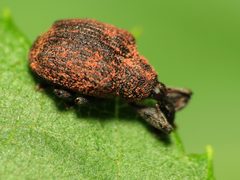
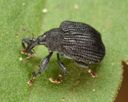
are small, dark weevils with a pronounced rostrum (snout) bearing elbowed . The body is compact and somewhat oval, typical of leaf-feeding Curculionidae. Larvae are legless, C-shaped that feed internally within leaf tissue, creating blotch mines visible from the upper leaf surface. Adults may be distinguished from other small leaf-mining weevils by association with tulip tree, sassafras, or magnolia , and by the characteristic notching pattern they produce on leaf margins.
Images
Habitat
Deciduous forests and wooded areas where trees—tulip tree, sassafras, or magnolia—occur. Also found in suburban and urban settings where these ornamental or native trees are planted.
Distribution
Eastern and southeastern United States, from Massachusetts south to the Gulf of Mexico, and west to the Mississippi River. Records also confirm presence in Ontario and Québec, Canada.
Seasonality
emerge in spring (April–May) to feed and mate. A second may occur in some regions, with late-season adults appearing in late summer to early autumn before in leaf litter.
Diet
feed externally on leaves of tulip tree (Liriodendron tulipifera), sassafras (Sassafras albidum), and various Magnolia , producing notched or scalloped leaf margins. Larvae are leaf miners, feeding internally within leaf tissue between the upper and lower .
Host Associations
- Liriodendron tulipifera - primary ( feeding, larval mining)
- Sassafras albidum - ( feeding, larval mining)
- Magnolia - ( feeding, larval mining)various
Life Cycle
Complete . are inserted into leaf tissue. Larvae feed as leaf miners, creating blotch mines, then pupate within the mine or in soil. emerge to feed on foliage, then overwinter in leaf litter or soil. One to two per year depending on latitude and climate.
Behavior
are primarily active during spring and may drop from foliage when disturbed, a common weevil defense . They feed nocturnally or during cooler periods, sheltering in leaf litter or bark crevices during hot daylight hours. Larval feeding is entirely concealed within leaf mines.
Ecological Role
Herbivore and . At densities, can cause significant defoliation of trees, though trees typically recover without long-term harm. Serves as prey for including birds and predatory insects.
Human Relevance
Occasional pest of ornamental tulip trees and magnolias in landscapes. are sporadic and usually self-limiting; control is rarely necessary. The has been used in research for plants, though not widely implemented.
Similar Taxa
- Phyllobius or other leaf-feeding CurculionidaeSimilar small size and general body form, but Odontopus calceatus is distinguished by specificity (tulip tree, sassafras, magnolia) and the combination of notching damage with larval blotch mines.
- Other leaf-mining beetles (e.g., some Chrysomelidae)Create similar leaf mines, but O. calceatus mines are associated with the distinctive notched leaf margins caused by feeding, and are diagnostic.