
Anthonomus quadrigibbus
Say, 1831
apple curculio
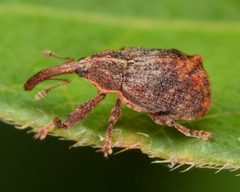
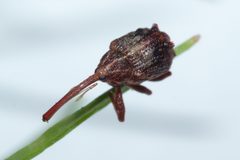
Anthonomus quadrigibbus, commonly known as the apple curculio, is a small weevil in the Curculionidae. It is a fruit-feeding pest native to North America, primarily associated with rosaceous fruit trees and shrubs. feed on developing fruits, causing significant damage, while larvae develop within the fruit, feeding on ovules. The species exhibits tight phenological synchronization with its plants, with adult and oviposition timed to specific flowering and fruit development stages.
Pronunciation
How to pronounce Anthonomus quadrigibbus: /ænˈθɒnəməs kwɑːdrɪˈdʒɪbəs/
These audio files are automatically generated. While they are not always 100% accurate, they are a good starting point.
Identification
The can be distinguished from other Anthonomus species by morphological features including the shape of the fore and fore tibiae, the structure of the male , and the coloration of body setae. The specific epithet "quadrigibbus" (four-humped) refers to characteristic on the pronotum.
Images
Habitat
Associated with rosaceous fruit-bearing shrubs and trees, particularly in temperate regions of North America. Overwinters as in leaf litter.
Distribution
Native to North America. Recorded from Canada (Alberta, British Columbia, Manitoba, New Brunswick, Nova Scotia, Ontario, Quebec, Saskatchewan) and throughout the contiguous United States (Alabama, Arizona, Arkansas, California, Colorado, Connecticut, Delaware, Florida, Georgia, Idaho, Illinois, Indiana, Iowa, Kansas, Kentucky, Louisiana, Maine, Maryland, Massachusetts, Michigan, Minnesota, Mississippi, Missouri, Montana, Nebraska, New Hampshire, New Jersey, New Mexico, New York, North Carolina, North Dakota, Ohio, Oklahoma, Oregon, Pennsylvania, Rhode Island, South Carolina, South Dakota, Tennessee, Texas, Utah, Vermont, Virginia, Washington, West Virginia, Wisconsin) and Mexico.
Seasonality
emerge from sites in mid- to late May, coinciding with anthesis and fruit drop of plants. Oviposition occurs toward the end of the fruit drop period, approximately 30 days after peak anthesis. Larval development occurs through June to mid-July, with new adults emerging in mid-July as fruits ripen. Adults then enter leaf litter to overwinter.
Diet
feed on unripe fruits of rosaceous . Larvae feed exclusively on ovules within developing fruits.
Host Associations
- Amelanchier alnifolia - primary Saskatoon berry; detailed phenological study conducted on this in Saskatchewan
- Malus - apple; reflected in "apple curculio"
- Prunus - stone fruits including cherries and plums
- Pyrus - pear
- Sorbus - mountain-ash
Life Cycle
Complete with one per year. are deposited singly in punctures at the base of fruits. Larvae complete development within the fruit, feeding on ovules. occurs within the fruit or in the soil. New generation emerge in mid-July and immediately seek sites in leaf litter.
Behavior
cause considerable damage to unripe fruits through feeding punctures. Oviposition is precisely timed to the end of the fruit drop period of the plant, with females depositing single in punctures at the fruit base. The exhibits strong phenological tracking of host plant development stages.
Ecological Role
Fruit-feeding herbivore that can act as a significant pest of rosaceous fruit crops and native fruit-bearing shrubs. As an in leaf litter, it contributes to litter dynamics.
Human Relevance
Recognized as a pest of apple and other rosaceous fruits. Listed as a of phytosanitary concern in Russia, indicating potential for international spread and establishment. The species has demonstrated potential beyond its native range.
Similar Taxa
- Anthonomus signatusStrawberry bud weevil; similar and fruit-feeding , but distinguished by of fore legs and male genitalia
- Anthonomus grandisBoll weevil; major cotton pest, distinguished by association and morphological features
- Anthonomus eugeniiPepper weevil; distinguished by plants and morphological characters used in diagnostic keys
More Details
Taxonomic history
Previously assigned to the Tachypterellus, but now placed in Anthonomus. Described by Thomas Say in 1831.
Diagnostic significance
Morphological features including fore leg structure and male form the basis of -level diagnostic keys for this and related harmful Anthonomus species.
Sources and further reading
- BugGuide
- Wikipedia
- GBIF taxonomy match
- iNaturalist taxon
- NCBI Taxonomy
- Catalogue of Life
- ID Challenge #9 | Beetles In The Bush
- Anthonomus quadrigibbus . [Distribution map].
- PHENOLOGY OFHOPLOCAMPA MONTANICOLAROHWER (TENTHREDINIDAE) ANDANTHONOMUS QUADRIGIBBUSSAY (CURCULIONIDAE) ON THEIR HOST PLANTAMELANCHIER ALNIFOLIANUTT. (ROSACEAE) IN SASKATCHEWAN
- О некоторых видах рода Anthonomus Germar (Coleoptera, Curculionidae), имеющих фитосанитарное значение для Российской Федерации