
Anthonomus eugenii
Cano, 1894
Pepper Weevil
, the pepper weevil, is a small curculionid and major agricultural pest of cultivated peppers (Capsicum spp.). Native to Mexico, it has spread throughout Central America, the Caribbean, the southern United States, and has been intercepted in more northern regions including Canada and Europe through imported infested fruit. The completes its entire development within pepper fruits, making it particularly difficult to control with conventional . Females exhibit -marking , depositing that deter subsequent oviposition by conspecifics.
Pronunciation
How to pronounce Anthonomus eugenii: //ænˈθɒnəməs juːˈdʒiːnaɪ//
These audio files are automatically generated. While they are not always 100% accurate, they are a good starting point.
Identification
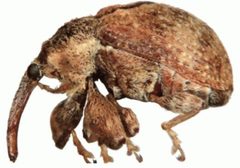
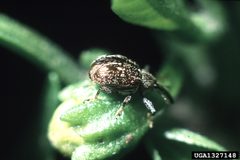
are approximately 3 mm in length with an oval-shaped body. Body color is dark brown with cream-colored covering the surface. The rostrum is distinctly curved, a characteristic of the Anthonomus. Females can be distinguished from males by a greater distance between the and on the rostrum, an thought to facilitate burrowing into fruits for oviposition.
Images
Habitat
Associated with cultivated and wild in the Capsicum and Solanum. In agricultural settings, found in pepper fields and areas with host plant availability. Development occurs entirely within the fruits of host plants.
Distribution
Native to Mexico. Established occur throughout Central America, the Caribbean, and the southern United States (Arizona, California, Florida, Georgia, Hawaii, Louisiana, New Mexico, North Carolina, South Carolina, Texas, Virginia). Northern range limited by cold temperatures and lack of winter material. Transient reported in more northern regions including Canada, the Netherlands, and northern U.S. states via imported infested fruit.
Seasonality
In Florida, lowest rates occur in late April, late June, and early August, suggesting seasonal fluctuations. Activity patterns correlate with plant availability and temperature.
Diet
and larvae feed on plants in the Capsicum and select Solanum (Solanaceae). Adults feed on flower buds and fruits. Larvae develop internally within fruits, feeding on internal tissues.
Host Associations
- Capsicum spp. - reproductive primary ; includes multiple cultivated pepper
- Solanum spp. - reproductive includes eggplant and some wild ; supports but not considered primary pest target
Life Cycle
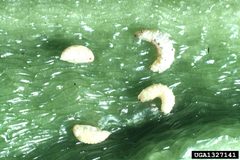
Females create an cavity in fruits using mouthparts and deposit a single egg, sealing the opening with a secretion that hardens into an oviposition plug. Mean is approximately 341 eggs per female lifetime, with 5–7 eggs laid per day. Egg stage lasts approximately 4.3 days. Three larval instars develop within the fruit over approximately 12.3 days; larvae are legless, C-shaped, with visible setae. occurs within the host fruit and lasts approximately 4.7 days; pupae resemble . Adults emerge through round exit holes. Total development from egg to adult averages 21.3 days at optimal temperatures.
Behavior
Females exhibit -marking : after oviposition, they deposit via and the hardened oviposition plug that deter other females from laying in the same fruit. This reduces among larvae. Females move within and among plants to locate unmarked fruits for oviposition.
Ecological Role
Herbivore specializing on Solanaceae. Serves as for multiple hymenopteran including Catolaccus hunteri, Triaspis eugenii, Urosigalphus spp., and others.
Human Relevance
Major economic pest of cultivated pepper (Capsicum) production. Can cause 70–90% rates in cultivated fields and up to 100% crop loss in severe cases. damage flower buds and fruits through feeding and oviposition; larval feeding within fruits causes direct damage and increases susceptibility to decay and . Management relies on monitoring with action thresholds (1 adult per 100 bud clusters or 5% damaged bud clusters), applications, and emerging approaches. Difficult to control chemically because stages are protected within fruits.
Similar Taxa
- Other Anthonomus speciesShared characteristics including curved rostrum; distinguished by association, body size, and coloration patterns
- Other pepper-infesting weevilsDistinguished by the combination of small size (3 mm), dark brown coloration with cream , and specific preferences for Capsicum and Solanum
Sources and further reading
- BugGuide
- Wikipedia
- GBIF taxonomy match
- iNaturalist taxon
- NCBI Taxonomy
- Catalogue of Life
- Pepper weevil, Anthonomus eugenii (Cano)
- Anthonomus eugenii . [Distribution map].
- Host‐marking by female pepper weevils, Anthonomus eugenii
- Natural enemies ofAnthonomus eugenii(Coleoptera: Curculionidae) in Canada
- Laboratory rearing of the pepper weevil, Anthonomus eugenii (Coleoptera: Curculionidae)
- Efecto de extractos botánicos sobre el picudo del chile (Anthonomus eugenii Cano). Resultados preliminares.
- Potencial de parasitoides para el control biológico de Anthonomus eugenii en diferentes variedades de chile
- Correlation of Temperatures With Host Plant Development and Degree of Infestation of The Pepper Weevil, Anthonomus Eugenii Cano, In California
- Development and Life History ofAnthonomus eugenii(Coleoptera: Curculionidae) at Constant Temperatures
- Global potential geographic distribution of Anthonomus eugenii under climate change: A comprehensive analysis based on an ensemble modeling approach
- Influence of Parental Age on Reproductive Potential and Embryogenesis in the Pepper Weevil, Anthonomus eugenii (Cano) (Col.: Curculionidae)
- A Modelling Approach to Describe the Anthonomus eugenii (Coleoptera: Curculionidae) Life Cycle in Plant Protection: A Priori and a Posteriori Analysis
- Development and Life History of <I>Anthonomus eugenii</I> (Coleoptera: Curculionidae) at Constant Temperatures
- NEW RECORDS OF NATURAL ENEMIES OF THE PEPPER WEEVIL, ANTHONOMUS EUGENII CANO (COLEOPTERA: CURCULIONIDAE), IN PUERTO RICO
- Management of Pepper Weevil (Anthonomus eugenii Cano) (Coleoptera: Curculionidae) Using Biorational and Conventional Insecticides in South Florida.
- Modeling the Historical and Future Potential Global Distribution of the Pepper Weevil Anthonomus eugenii Using the Ensemble Approach.
- Projecting Current and Future Habitat Suitability of the Pepper Weevil, Anthonomus eugenii Cano, 1894 (Coleoptera: Curculionidae), in China: Implications for the Pepper Industry.