
Phrydiuchus tau
Warner, 1969
Mediterranean sage root weevil
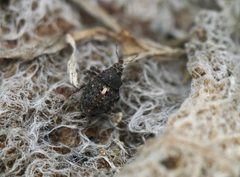
Phrydiuchus tau is a small weevil in the Curculionidae, commonly known as the Mediterranean sage root weevil. It is native to southern Eurasia and has been introduced to the western United States as a agent targeting the weed Mediterranean sage (Salvia aethiopis). The derives its from the distinctive white T-shaped marking on its surface, resembling the Greek letter tau.
Pronunciation
How to pronounce Phrydiuchus tau: /ˈfrɪdjʊkəs taʊ/
These audio files are automatically generated. While they are not always 100% accurate, they are a good starting point.
Identification
The combination of small size (approximately 5 mm), dark gray to black coloration, and the distinctive white T-shaped marking distinguishes Phrydiuchus tau from similar weevils. The specific association with Mediterranean sage can aid in field identification where the weevil has been introduced for biocontrol purposes.
Images
Appearance
weevils are dark gray to black in coloration, approximately 5 millimeters in length. The most distinctive feature is a white marking on the surface shaped like the letter T, which gives the its name. The body form is typical of small curculionid weevils.
Habitat
Associated with Mediterranean sage (Salvia aethiopis) and related Salvia . In its native range in southern Eurasia, it occurs in supporting its plants. In introduced regions of the western United States, it is found in areas where Mediterranean sage has established, including rangelands and disturbed sites.
Distribution
Native to southern Eurasia. Introduced to the United States in 1971 for purposes. Established in much of the western United States, including Idaho and other states with Mediterranean sage .
Diet
feed on foliage of plants. Larvae feed internally on plant tissue, tunneling down to the root crown where they develop.
Host Associations
- Salvia aethiopis - primary Mediterranean sage; target of introductions
- Salvia sclarea - secondary clary sage; readily attacked but less preferred than S. aethiopis
Life Cycle
Females lay at the base or on the underside of leaves. Larvae emerge after three to four weeks and burrow into plant tissue, tunneling to the root crown where they feed and develop. The larval stage causes the majority of plant damage. occurs within the root crown area.
Behavior
females oviposit on plant foliage near the base or on leaf undersides. Larvae exhibit endophytic feeding , tunneling through plant tissue from the point of entry down to the root crown. Larval feeding can kill small host plants or stunt larger plants, potentially preventing .
Ecological Role
herbivore of Salvia . In its introduced range, functions as a agent reducing of the weed Mediterranean sage. The larval stage is the primary damaging life stage, with feeding at the root crown being particularly injurious to plants.
Human Relevance
Used as an agent of biological pest control against Mediterranean sage (Salvia aethiopis), a noxious weed in the western United States. First introduced to the United States in 1971. The weevil has established self-sustaining in multiple western states and contributes to management of sage .
Similar Taxa
More Details
Biological control efficacy
Larval feeding at the root crown is more damaging than foliage feeding. Small Mediterranean sage plants can be killed by larval damage alone; larger plants may be stunted or rendered unable to reproduce.
Nomenclature
The specific epithet 'tau' refers to the Greek letter τ, which the white marking resembles.
Sources and further reading
- BugGuide
- Wikipedia
- GBIF taxonomy match
- iNaturalist taxon
- NCBI Taxonomy
- Catalogue of Life
- Honoring Joseph Tauzer: The Multitasker | Bug Squad
- CDFA to Host Fruit Fly Workshop, Free to Participants | Bug Squad
- Bee-ing There: A Buzzworthy Event | Bug Squad
- Taum Sauk Mountain – Missouri’s High Point | Beetles In The Bush
- Bug Eric: What the Insects Have Taught Me
- Is This Non-Native Mason Bee an Invasive Species?
- Bionomics of Phrydiuchus tau (Coleoptera: Curculionidae) Associated with Mediterranean Sage in Idaho