
Cathartus
Reiche, 1854
Species Guides
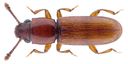
1- Cathartus quadricollis(square-necked warrior beetle)
Cathartus is a of flat bark beetles in the Silvanidae, containing the single Cathartus quadricollis. The genus is known from both stored product environments and agricultural systems, with documented in Hawaii functioning as of scolytine pests. Laboratory studies have characterized its developmental on various grain substrates.
Pronunciation
How to pronounce Cathartus: /kæˈθɑːrtəs/
These audio files are automatically generated. While they are not always 100% accurate, they are a good starting point.
Identification
The Cathartus is distinguished within Silvanidae by containing only the C. quadricollis, commonly known as the square-necked grain . Specific morphological diagnostic features for the genus are not documented in available sources.
Images
Habitat
Documented in two distinct contexts: stored product environments (grains and legume seeds including maize, sorghum, wheat, cowpea, and melon) and agricultural landscapes (coffee farms, macadamia nut farms, and surrounding vegetation in Hawaii). In Hawaii, various life stages have been found in seven different plant common to agricultural areas.
Distribution
Hawaii (documented in coffee and macadamia nut agricultural systems); Southeast Asia (GBIF distribution records).
Diet
Predatory on scolytine beetles including (), Hypothenemus obscurus (tropical nut borer), and Xylosandrus compactus (black twig borer) in Hawaii agricultural systems. Also develops on stored grains and legume seeds (maize, sorghum, wheat, cowpea, melon) in laboratory conditions.
Host Associations
- Hypothenemus hampei - -prey; rate ~40% on in artificial coffee berries
- Hypothenemus obscurus - -preytropical nut borer
- Xylosandrus compactus - -preyblack twig borer
- Zea mays - developmental substratemaize; optimal laboratory development with mean growth rate 22.4 after 2 weeks
- Sorghum bicolor - developmental substratesorghum
- Triticum aestivum - developmental substratewheat
- Vigna unguiculata - developmental substratecowpea; poorest laboratory development with mean growth rate 1.6 after 2 weeks
- Cucumis melo - developmental substratemelon
Life Cycle
stage: 3-7 days incubation, 95.5% hatchability. Five larval instars confirmed via -capsule width measurements, growth ratio 1.05-1.20 (mean 1.12) consistent with . Total developmental period 18.80 days (cut maize) to 30.70 days (cut cowpea) depending on food substrate. and documented in laboratory.
Behavior
Limited from release sites in trials, with recaptures near release points at 1, 2, and 7 weeks after release.
Ecological Role
Natural enemy of significant agricultural scolytine pests in Hawaii; candidate for . Also functions as stored product pest on grains and legumes.
Human Relevance
Potential agent for and other scolytine pests in tropical agriculture. Also a pest of stored grains and legumes.
Similar Taxa
- LeptophloeusCo-occurring predatory flat bark beetle in Hawaii with similar ecological role; distinguished by placement (Laemophloeidae vs. Silvanidae)
More Details
Taxonomic Note
Cathartus is , containing only C. quadricollis. The name has been misspelled as 'Carthartus' in some literature.
Laboratory vs. Field Ecology
Available data derive from two distinct research contexts: laboratory developmental studies on stored products (no field data) and field studies in Hawaii agricultural systems (no stored product context). The relationship between these two ecological modes is not established.
Sources and further reading
- BugGuide
- Wikipedia
- GBIF taxonomy match
- iNaturalist taxon
- NCBI Taxonomy
- Biology of Cathartus Quadricollis Guerin-Meneville (Coleoptera:Silvanidae) on Some Selected Food Media
- Feeding habits, movement, and reproduction of the predatory flat bark beetles Cathartus quadricollis (Coleoptera: Silvanidae) and Leptophloeus sp. (Coleoptera: Laemophloeidae) in Hawaii coffee and macadamia nut