
Enicmus histrio
Joy & Tomlin, 1910
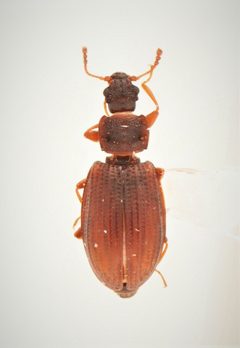
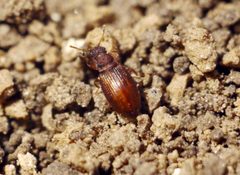
Enicmus histrio is a of minute brown scavenger beetle in the Latridiidae, described by Joy & Tomlin in 1910. The species is native to Europe and has been recorded in Belgium, with additional distribution records from New Brunswick and Nova Scotia in Canada. Like other members of Latridiidae, it is associated with moist, decaying organic matter. Specific ecological details for this species remain poorly documented in published literature.
Pronunciation
How to pronounce Enicmus histrio: /ˈe.nik.mus ˈhɪs.tri.oʊ/
These audio files are automatically generated. While they are not always 100% accurate, they are a good starting point.
Images
Distribution
Native to Europe. Documented occurrences include Belgium (where it has been recorded as absent in some surveys), and the Canadian provinces of New Brunswick and Nova Scotia. The mechanism of its presence in North America—whether through natural range extension, human introduction, or historical —has not been established in available sources.
More Details
Taxonomic Note
The specific epithet 'histrio' (Latin for 'actor' or 'player') is shared with several unrelated insect , most notably the harlequin bug Murgantia histrionica (Hemiptera: Pentatomidae), a major agricultural pest in North America. The two species belong to entirely different orders (Coleoptera vs. Hemiptera) and have no close relationship. This homonymy has no biological significance but may cause confusion in literature searches. The context provided in the source materials pertains entirely to Murgantia histrionica, not Enicmus histrio.
Data Limitations
Available sources for Enicmus histrio are limited to taxonomic databases (GBIF, NCBI, iNaturalist) and a brief Wikipedia entry. No peer-reviewed ecological, behavioral, or morphological studies specifically addressing this were found in the provided context. The Latridiidae as a whole is associated with mold-feeding habits in damp environments, but species-level traits for E. histrio cannot be reliably inferred.
Sources and further reading
- BugGuide
- Wikipedia
- GBIF taxonomy match
- iNaturalist taxon
- NCBI Taxonomy
- Harlequin hijinks - Harlequin bug, Murgantia histrionica — Bug of the Week
- Harlequin hijinks: Harlequin bug, Murgantia histrionica — Bug of the Week
- Bugs in Orange and Black, Part 1: Nightmare for collards when harlequin bugs arrive - Murgantia histrionica — Bug of the Week
- Bug Eric: Harlequin Bug
- Harlequin Bug Coloration Influenced by Temperature During Nymphal Stages
- Bug Eric: The Bagrada Bug