
Hyperaspis octavia
Casey, 1908
Octavia Lady Beetle
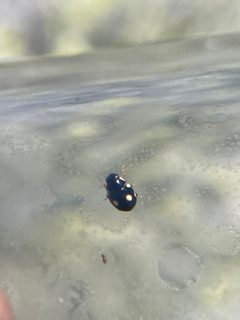
Hyperaspis octavia is a small lady beetle in the Coccinellidae, measuring approximately 2.5 mm in length. It is native to North America and has been recorded from Mississippi, Quebec, Michigan, New Brunswick, Nova Scotia, and Ontario. Like other members of the Hyperaspis, it is a of scale insects. The exhibits distinctive coloration with a shiny black body and pale red-brown spots, along with paler brown legs.
Pronunciation
How to pronounce Hyperaspis octavia: //haɪˈpɜːrəs.pɪs ɒkˈteɪ.viə//
These audio files are automatically generated. While they are not always 100% accurate, they are a good starting point.
Identification
Distinguished from other Hyperaspis by specific spot pattern and coloration details. The combination of small size (2.5 mm), shiny black with pale red-brown spots, and paler brown legs provides field marks. Larvae of Hyperaspis species are covered in white waxy secretions and resemble mealybugs; they can be distinguished from actual mealybugs by their more rapid movement when disturbed. may be confused with other black lady beetles with red or orange markings, but the specific spot arrangement and pale red-brown (rather than bright red or orange) spot coloration are distinctive.
Images
Habitat
Associated with trees and shrubs infested with scale insects, particularly in urban and suburban settings. Found in deciduous and mixed forest environments where scale insects occur.
Distribution
North America. Documented occurrences include Mississippi, Michigan, and Quebec in the United States and Canada. Additional records from New Brunswick, Nova Scotia, and Ontario indicate a northeastern and north-central distribution pattern.
Seasonality
are active during the growing season when insect prey is available. Based on -level , adults likely overwinter in protected locations beneath bark or in leaf litter, emerging in spring to lay . Larval development occurs through summer, with new adults appearing in late summer to autumn.
Diet
of scale insects (Coccidae and related ). Both larvae and feed on scale insects and their . Larvae in particular are voracious, capable of consuming thousands of scale insects during development.
Host Associations
- Crapemyrtle bark scale - Hyperaspis documented as important natural enemy of this pest
- Tuliptree scale - -level association with this magnolia pest
- Scale insects (Coccidae) - General prey group for
Life Cycle
Complete with , larva, pupa, and stages. Eggs are laid near insect colonies. Larvae develop through several instars, feeding heavily on scale insects while concealed beneath white waxy secretions. occurs after larval development is complete. Adults emerge, continue feeding on scales, then seek sites. One or more per year depending on climate.
Behavior
Larvae produce white waxy secretions from glands along their sides, creating a protective coating that resembles mealybugs and deters aggression. When disturbed, larvae move more rapidly than actual mealybugs, providing a behavioral cue for identification. actively search for insect colonies and are efficient . Both life stages are .
Ecological Role
Important agent of insect . As a , helps regulate of native and scale insects on trees and shrubs. Contributes to natural pest suppression in forest, urban, and agricultural .
Human Relevance
Beneficial insect of significant value in . Provides free of scale insects that damage ornamental trees, including crapemyrtles and magnolias. Frequently misidentified and killed due to larval resemblance to mealybugs; education about correct identification is important for conservation. No negative impacts on humans.
Similar Taxa
- Mealybugs (Pseudococcidae)Hyperaspis larvae are covered in white wax and closely resemble mealybugs, leading to mistaken identity and unnecessary applications. Larvae can be distinguished by faster movement when disturbed.
- Other Hyperaspis speciesMany Hyperaspis share similar black coloration with red, orange, or yellow markings. Specific spot pattern, size, and geographic distribution help distinguish H. octavia.
- Generalist lady beetles (e.g., Harmonia axyridis)Share characteristics but differ in color pattern (often brighter red and black) and prey range (more vs. ).
Misconceptions
The most significant misconception involves larval identification: Hyperaspis larvae are frequently mistaken for mealybugs or other plant pests due to their white waxy coating, leading to their destruction by applications. They are beneficial , not pests.
More Details
Conservation note
Due to frequent misidentification of larvae as pests, Hyperaspis may be inadvertently reduced by unnecessary use. Correct identification and conservation of these beetles supports natural of scale insects.
Wax production function
The white waxy coating produced by larvae serves as protection against aggression. Ants frequently tend scale insects for honeydew and would otherwise attack lady beetle larvae; the wax reduces detection and aggression from ants.