
Hyperaspis conviva
Casey, 1924
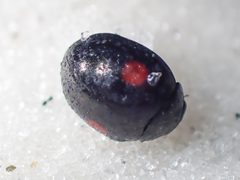
Hyperaspis conviva is a small lady beetle native to North America. measure 2.70–3.80 mm and display a black body with red spot patterning similar to Hyperaspis signata. The is a specialized of scale insects, with larvae producing a distinctive white waxy coating that serves as camouflage and protection against ants and other predators. The waxy larvae are frequently mistaken for mealybugs, leading to unnecessary mortality from applications.
Pronunciation
How to pronounce Hyperaspis conviva: //haɪˈpɛrəspɪs kənˈvaɪvə//
These audio files are automatically generated. While they are not always 100% accurate, they are a good starting point.
Identification
can be distinguished from other small black Coccinellidae by the combination of size (2.70–3.80 mm), shiny black with red spots, and the specific spot pattern similar to Hyperaspis signata. Larvae are distinguished from mealybugs by their : when disturbed, Hyperaspis larvae move quickly, whereas mealybugs remain sedentary. The waxy larval coating is produced by the itself, not acquired externally.
Images
Appearance
are small beetles, 2.70–3.80 mm in length. The body is shiny black with red spots on the ; the specific spot pattern resembles that of Hyperaspis signata. Larvae are covered in a dense white waxy secretion produced from glands along the sides of the body, giving them a mealybug-like appearance. This waxy coating extends over the body and may help deter .
Habitat
Associated with trees and shrubs infested with scale insects, particularly crapemyrtle and magnolia. Found in urban, suburban, and natural settings where scale insects occur. overwinter in protected locations beneath bark or in leaf litter.
Distribution
North America. Recorded from Canada (Manitoba, Ontario, Québec) and the United States (Alabama, Florida, Louisiana, Maine, Maryland, New Jersey, New York, North Carolina, Pennsylvania, Virginia, West Virginia, Washington D.C., and Saskatchewan).
Seasonality
Larvae active during spring and summer, feeding on scale insects. present from late summer through autumn. By early December, adults depart -infested trees to overwinter in protected locations. Adults return to trees in spring to reproduce.
Diet
Specialized of scale insects (Coccoidea). Larvae consume insect and stages; a single larva may eat several thousand immature scale insects during development. continue to feed on scale insects. Documented on crapemyrtle bark scale (Acanthococcus lagerstroemiae) and tuliptree scale (Toumeyella liriodendri).
Host Associations
- Crapemyrtle bark scale - preyAcanthococcus lagerstroemiae; major target of
- Tuliptree scale - preyToumeyella liriodendri; documented prey on magnolia
- Scale insects - preyGeneralized insect
Life Cycle
laid on or near -infested trees in spring. Larvae hatch and feed on scale insects, producing waxy coating for protection. Larvae complete development through autumn, consuming thousands of scale insects. occurs in late summer to autumn. emerge, feed on scale insects, then migrate to sites by early December. Adults return to trees the following spring to mate and oviposit.
Behavior
Larvae are active that move quickly when disturbed, unlike the sedentary mealybugs they resemble. and larvae hunt scale insects on bark and foliage. The larval waxy coating is a defensive that reduces by ants and other enemies. Adults overwinter in beneath bark or in leaf litter.
Ecological Role
Important agent of insect pests. Helps suppress of scale insects such as crapemyrtle bark scale. Consumes significant numbers of pest insects, reducing honeydew production and associated problems. Serves as prey for various despite defensive wax.
Human Relevance
Beneficial insect for biological pest control in horticultural and urban settings. Frequently misidentified as a pest (mealybug) due to larval appearance, leading to unnecessary applications that harm . Conservation of this supports natural suppression of insect .
Similar Taxa
- Hyperaspis signataSimilar color pattern; both black with red spots, requiring close examination for separation
- Mealybugs (Pseudococcidae)Larvae superficially resemble mealybugs due to white waxy coating; distinguished by rapid movement when disturbed versus sedentary of mealybugs
- Other Hyperaspis speciesShared characteristics including small size, dark coloration with contrasting spots, and waxy larvae; -level identification requires examination of spot pattern and genitalia
Misconceptions
The most significant misconception is the identification of waxy larvae as mealybugs or other pests, resulting in applications that kill beneficial . The white waxy coating is frequently assumed to indicate a plant pest rather than a protective of a predatory .