
Brachiacantha decora
Casey, 1899
Decorated Spurleg, decorated lady beetle
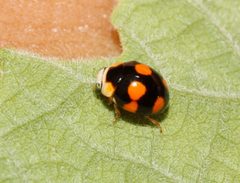
Brachiacantha decora Casey, 1899 is a North American lady beetle ( Coccinellidae) historically recognized as a distinct . A 2020 taxonomic revision synonymized it with Brachiacantha bistripustulata (Fabricius, 1801), rendering B. decora a junior synonym. The species belongs to the dentipes species group within Brachiacantha. No independent biological data exist for B. decora as a separate ; all ecological information refers to the synonymized B. bistripustulata.
Pronunciation
How to pronounce Brachiacantha decora: //ˌbræk.i.əˈkæn.θə dɪˈkɔː.rə//
These audio files are automatically generated. While they are not always 100% accurate, they are a good starting point.
Identification
Brachiacantha decora cannot be reliably distinguished from Brachiacantha bistripustulata; the two are now considered . Members of the dentipes group, to which this belongs, are characterized by specific genitalic features and typically exhibit spotted or patterned . Accurate identification requires examination of male genitalia or reference to the taxonomic revision that established the synonymy.
Images
Distribution
North America. The synonymized B. bistripustulata occurs in the Neotropical region including the United States, Mexico, and Central America.
Similar Taxa
- Brachiacantha bistripustulata (Fabricius, 1801)B. decora was synonymized with this in 2020; they are now considered the same biological entity.
- Brachiacantha dentipes (Fabricius, 1801)Belongs to the same dentipes group and shares similar ; distinguished by genitalic characters and elytral pattern.
More Details
Taxonomic Status
B. decora was described by Casey in 1899 but was recognized as a synonym of B. bistripustulata in a 2020 revision (Zootaxa 4701: 551–565). The name B. decora should no longer be used for current specimens.
Data Limitations
No peer-reviewed sources provide independent biological data for B. decora as a distinct . All , dietary, and ecological information in literature refers to the currently accepted name B. bistripustulata.
Sources and further reading
- BugGuide
- GBIF taxonomy match
- iNaturalist taxon
- It's Bugged! And You Won't Want to Miss It! | Bug Squad
- Decorations on the Christmas tree: Egg cases of the European mantis, Mantis religiosa, Chinese mantis, Tenodera sinensis, and Carolina mantis, Stagmomantis carolina — Bug of the Week
- Decorations on the Christmas tree: Egg cases of the European mantis, Mantis religiosa, Chinese mantis, Tenodera sinensis, and Carolina mantis, Stagmomantis carolina — Bug of the Week
- Tinsel, the Christmas spider and other arthropods that decorate your holiday tree — Bug of the Week
- Amorpha borer on goldenrod | Beetles In The Bush
- The gift of poinsettia. The silverleaf whitefly, Bemisia argentifolii — Bug of the Week
- Contribution to the knowledge of the dentipes group of the genus Brachiacantha (Coleoptera: Coccinellidae)