
Neoharmonia venusta
(Melsheimer, 1847)
V-marked Lady Beetle
Species Guides
2- Neoharmonia venusta ampla(V-marked Lady Beetle)
- Neoharmonia venusta venusta(V-marked Lady Beetle)
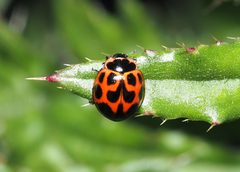
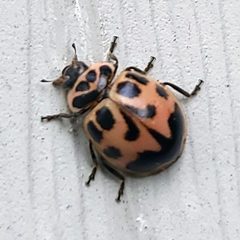
Neoharmonia venusta is a of lady beetle (Coccinellidae) found across much of North America and Mexico. The species comprises two recognized : N. v. venusta in the eastern and central United States, and N. v. ampla in the southwestern U.S. and Mexico. The nominate subspecies displays a metallic blue coloration with an orange pronotum, while the southwestern subspecies N. v. ampla is notably less commonly encountered.

Pronunciation
How to pronounce Neoharmonia venusta: //ˌniːoʊhɑːrˈmoʊniə vəˈnʌstə//
These audio files are automatically generated. While they are not always 100% accurate, they are a good starting point.
Identification
The nominate N. v. venusta is distinguished by metallic blue with an orange pronotum, creating a striking color contrast. The southwestern subspecies N. v. ampla shares this general pattern but may show geographic variation in color intensity. As the sole member of its , N. venusta can be separated from other Coccinellidae by its unique combination of metallic blue coloration, orange pronotum, and specific elytral markings that form a V-shape or related pattern.
Images
Distribution
Recorded from Maine to Florida, west to Michigan, Nebraska, Texas, New Mexico, and Arizona. Also found in Mexico. The nominate N. v. venusta occupies the range from Maine to Florida, west to Michigan, Nebraska, and eastern Texas. The subspecies N. v. ampla occurs in Mexico, Arizona, New Mexico, and Texas.
More Details
Subspecies
Two are recognized: Neoharmonia venusta venusta (eastern/central U.S.) and Neoharmonia venusta ampla (southwestern U.S. and Mexico). The subspecies ampla was described by Mulsant in 1850.
Taxonomic Notes
Neoharmonia is a containing only N. venusta. The genus is classified within the Coccinellidae (lady beetles).