
Mulsantina picta
(Randall, 1838)
Painted Lady Beetle, Pine Lady Beetle
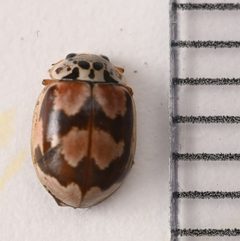
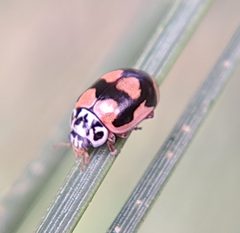
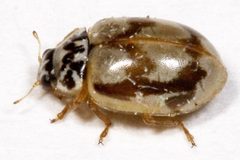
Mulsantina picta is a small lady beetle native to North America, commonly found in pine forest across the United States and southern Canada. The is a specialized of aphids and adelgids associated with conifers. measure 3.3–5.3 mm in length and exhibit variable elytral patterning. The species has been observed to dominate in older pine stands despite low densities in these habitats.
Pronunciation
How to pronounce Mulsantina picta: //mʊlˈsæn.tɪ.nə ˈpɪk.tə//
These audio files are automatically generated. While they are not always 100% accurate, they are a good starting point.
Identification
Distinguished from similar lady beetles by the more constant pronotal markings, which remain recognizable even when elytral markings are reduced or absent. The small size and association with conifer provide additional context. Separation from other Mulsantina requires examination of specific pattern elements on the pronotum and .
Images
Habitat
Primarily associated with pine forests and conifer-dominated . Particularly abundant in older pine stands. Occupies habitats with low densities, suggesting to resource-limited conifer environments.
Distribution
Widespread across the United States and southern Canada.
Diet
Host Associations
- Pinus - Primary forest type; older pine stands support .
- Aphidoidea - preyPrimary prey items in conifer .
- Adelgidae - preySpecialized on conifer-feeding adelgids.
Behavior
Has been observed to maintain dominance in older pine tree despite low densities, suggesting efficient resource utilization or competitive advantage in conifer .
Ecological Role
Human Relevance
Potential agent for conifer pests; no significant negative impacts documented.
Similar Taxa
- Other CoccinellinaeMulsantina picta is distinguished by its small size, variable elytral pattern with stable pronotal markings, and specific association with conifer .
More Details
Nomenclature
Originally described as Coccinella picta by J. W. Randall in 1838; subsequently transferred to Mulsantina.
Ecological dominance
The achieves dominance in older pine despite low prey densities, an unusual pattern suggesting strong conifer specialization.