
Mulsantina hudsonica
(Casey, 1899)
Hudsonian lady beetle, Hudsonian Ladybird
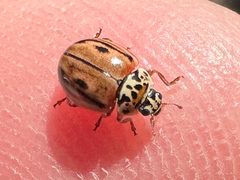
Mulsantina hudsonica, known as the Hudsonian lady , is a small predatory beetle in the Coccinellidae. It is native to North America with a broad transcontinental range. The is recognized by its distinctive yellow coloration with black markings on the and pronotum, and brown and black patterns on the . It has been documented as a of the balsam woolly adelgid.
Pronunciation
How to pronounce Mulsantina hudsonica: //mʌlˈsæntɪnə hʌdˈsɒnɪkə//
These audio files are automatically generated. While they are not always 100% accurate, they are a good starting point.
Identification
Distinguished from other Mulsantina and similar yellow lady beetles by the combination of: two black lines on the (not spots), pronotal spots forming a distinct M-shape, and the presence of a brown vitta plus two black spots on each . The small size (under 5 mm) and association with coniferous may aid field identification.
Images
Habitat
Associated with coniferous forests. Recorded from various conifer and from willow.
Distribution
North America. Recorded from Labrador to North Carolina, west to British Columbia and Alberta.
Diet
. Preys on the balsam woolly adelgid (Adelges piceae).
Host Associations
- Adelges piceae - preybalsam woolly adelgid
- conifers - various
- willow - Salix
Ecological Role
of conifer pests, specifically documented as a agent of the balsam woolly adelgid.
Human Relevance
Potential value in of the balsam woolly adelgid, a significant pest of balsam fir and other conifers.
Similar Taxa
- Other Mulsantina speciesShare -level characteristics; distinguished by specific spot patterns and coloration details
- Other yellow CoccinellidaeSimilar general appearance; M. hudsonica distinguished by unique lines, M-shaped pronotal pattern, and elytral vitta
More Details
Taxonomic history
Originally described as Cleis hudsonica by Casey in 1899 before transfer to Mulsantina.