
Hippodamia caseyi
Johnson, 1910
Casey's lady beetle, Casey's ladybird
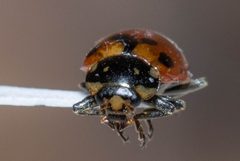
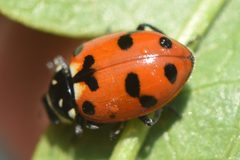
Hippodamia caseyi, commonly known as Casey's lady beetle, is a small lady beetle in the Coccinellidae. measure 4.80–6.70 mm in length. The species is native to western North America, with confirmed records from British Columbia, California, Colorado, Idaho, Montana, Oregon, Utah, Washington, and Alberta. The pronotum sometimes displays pale spots. Like other members of the Hippodamia, it is likely a of small insects such as aphids, though specific ecological studies for this species are limited.
Pronunciation
How to pronounce Hippodamia caseyi: /hɪpoʊˈdeɪmiə ˈkeɪsi/
These audio files are automatically generated. While they are not always 100% accurate, they are a good starting point.
Identification
Hippodamia caseyi can be distinguished from other Hippodamia by its small size (4.80–6.70 mm) and the occasional presence of pale spots on the pronotum. It is smaller than the well-known convergent lady beetle (Hippodamia convergens), which typically exceeds 6 mm. Definitive identification to species level within Hippodamia often requires examination of genitalic structures and comparison with , as external morphological differences can be subtle. The western North American distribution helps narrow possibilities, as H. caseyi does not overlap with several eastern Hippodamia species.
Images
Appearance
are small lady beetles, 4.80–6.70 mm in length. The pronotum (the shield-like structure behind the ) sometimes bears pale spots. Overall body form is typical of the Hippodamia—elongate-oval and somewhat flattened compared to more rounded lady beetles. Coloration and exact elytral (wing cover) pattern are not detailed in available sources.
Distribution
Western North America. Confirmed records from: British Columbia (Canada), Alberta (Canada), California, Colorado, Idaho, Montana, Oregon, Utah, and Washington (United States). The appears restricted to this region, with no confirmed records from eastern North America or other continents.
Similar Taxa
- Hippodamia convergensLarger size (typically 6–7 mm), more prominent converging white or pale lines on the pronotum behind the (giving the its ), and broader North American distribution including eastern regions.
- Hippodamia parenthesisDistinctive paired pale spots on the pronotum that resemble parentheses, and generally larger size.
- Other small Hippodamia speciesMany western Hippodamia overlap in size and general appearance; reliable separation often requires examination of male genitalia and comparison with type material.
More Details
Taxonomic history
Described by Johnson in 1910. The epithet 'caseyi' likely honors an individual, though the exact etymology is not documented in readily available sources.
Research status
Despite being described over a century ago, H. caseyi has received limited dedicated study. Most ecological and behavioral information must be inferred cautiously from the level, as -specific research is sparse. The 981 iNaturalist observations (as of source date) suggest it is regularly encountered by naturalists in its range, yet it is far less studied than the economically important H. convergens.
Sources and further reading
- BugGuide
- Wikipedia
- GBIF taxonomy match
- iNaturalist taxon
- Birds, Bats or a Bloom? But No Splat! | Bug Squad
- Researchers Share New Method for Detecting Insect Egg Predators
- Bacteria Can Aid Aphids Against Predation and Parasitism
- From Burglars to Bugs: Anti-Theft Dye Useful in Insect-Tracking Studies
- Hispanic Heritage Month: Publications Showcase
- Sulfoxaflor Found to Be Less Harmful to Beneficial Predators of Soybean Aphids