
Coccinella prolongata
Crotch, 1873
Prolongate Lady Beetle
Coccinella prolongata, the prolongate lady beetle, is a of lady beetle in the Coccinellidae. It is a small measuring 5.7–7 mm in length, with distinctive black and pale markings on the , pronotum, and . The species is native to western North America and comprises three recognized with somewhat different geographic ranges. Like other members of the Coccinella, it is presumed to be a of soft-bodied insects such as aphids.
Pronunciation
How to pronounce Coccinella prolongata: //ˌkɒksɪˈnɛlə prəʊˈlɒŋɡətə//
These audio files are automatically generated. While they are not always 100% accurate, they are a good starting point.
Identification
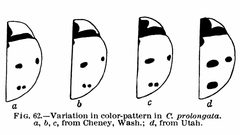
Distinguished from the seven-spotted lady beetle (Coccinella septempunctata) and nine-spotted lady beetle (Coccinella novemnotata) by its specific spot pattern: two spots per plus scutellar spot, rather than seven or nine total spots. The pronotal pattern with large anterolateral pale spots is more extensive than in C. septempunctata, which has only pale 'lapels' at the pronotal corners. Distinguished from Coccinella transversoguttata by having separate spots rather than connected transverse bars. The small size (5.7–7 mm) and western North American range further assist identification.
Images
Habitat
Specific details are not well documented in available sources. Based on distribution records, the occurs in a variety of across western North America including montane, foothill, and possibly agricultural environments.
Distribution
North America: recorded from British Columbia, California, Colorado, Idaho, Montana, Nebraska, Nevada, Oregon, Washington, and Wyoming. Three recognized: C. p. prolongata (widespread across most of range), C. p. bridwelli (California), and C. p. sequoiae (California, Nevada).
Ecological Role
Presumed based on membership, though specific ecological studies are lacking.
Similar Taxa
- Coccinella septempunctataSeven-spotted lady beetle has seven total spots (three on each plus scutellar spot) and pronotum with only corner 'lapels' pale rather than large anterolateral spots; introduced more widespread across North America.
- Coccinella novemnotataNine-spotted lady beetle has nine total spots and entire pronotal 'collar' white from corner to corner; native now rare in much of former range.
- Coccinella transversoguttataTransverse lady beetle has spots on near pronotum connected to form horizontal black bar between 'shoulders' rather than separate spots.
More Details
Taxonomic Status
GBIF lists the status as 'DOUBTFUL', suggesting some taxonomic uncertainty or need for revision that should be noted when consulting this record.
Subspecies
Three are recognized with partially overlapping but distinct ranges; C. p. bridwelli and C. p. sequoiae are restricted to California and adjacent Nevada, while the nominate subspecies occupies the broader range.
Sources and further reading
- BugGuide
- Wikipedia
- GBIF taxonomy match
- iNaturalist taxon
- A Mural Like No Other | Bug Squad
- Deep Look's Award-Winning Aphid Video by Josh Cassidy--and a UC Davis Entomologist's Role | Bug Squad
- Bug Eric: "Zombie Ladybugs"
- Tabloid Sensationalism Aside, Lady Bugs Are Still Fascinating
- Bug Eric: ID Tip: Seven-spotted or Nine-spotted Lady Beetle?
- Bug Eric: December 2016