
Coccinella monticola
Mulsant, 1850
mountain lady beetle, Tamarack ladybug
Coccinella monticola is a of lady beetle native to western North America, with disjunct in the northeastern United States and southeastern Canada. measure 5.2 to 7 mm in length and are distinguished by two oval spots on each plus a single spot behind the . The species is known to occur in montane and northern forest , including areas with tamarack (Larix laricina), which contributes to one of its . It can be confused with the similar Coccinella difficilis.
Pronunciation
How to pronounce Coccinella monticola: /ˌkɔk.sɪˈnɛl.lə mɒnˈtɪ.kə.lə/
These audio files are automatically generated. While they are not always 100% accurate, they are a good starting point.
Identification
Distinguished from similar Coccinella by the combination of two oval spots per and a single pronotal spot. Most reliably separated from Coccinella difficilis by subtle differences in spot configuration and body proportions, though examination may be required for definitive identification. Spot count alone is unreliable due to intraspecific variability in spot size and shape.
Images
Appearance
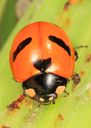
are 5.2–7 mm long. Each bears two similar oval spots, with an additional single spot located behind the on the pronotum. Spot size and roundedness vary among individuals. Forewing coloration ranges from red to orange or yellow. The overall body form is convex and typical of the Coccinella.
Habitat
Montane forests and northern woodland . Associated with coniferous forests including tamarack (Larix laricina) stands, which contributes to the "Tamarack ladybug." Occurs from subalpine elevations in the western range to and mixed forests in the eastern portion of its distribution.
Distribution
Western North America from Yukon Territory south to New Mexico, with range extending eastward through Washington to Wisconsin. Disjunct in northeastern North America from the Great Lakes region east to Nova Scotia and Massachusetts. Present in Canadian provinces including Alberta, British Columbia, and Manitoba.
Host Associations
- Larix laricina - associated with "Tamarack ladybug" reflects this association
Similar Taxa
- Coccinella difficilisSimilar spot pattern with two elytral spots; requires careful examination to distinguish
More Details
Nomenclature note
The "Tamarack ladybug" specifically references the tamarack tree (Larix laricina), indicating a association in the eastern portion of its range where this tree occurs.
Sources and further reading
- BugGuide
- Wikipedia
- GBIF taxonomy match
- iNaturalist taxon
- A Mural Like No Other | Bug Squad
- Bug Eric: "Zombie Ladybugs"
- Bug Eric: ID Tip: Seven-spotted or Nine-spotted Lady Beetle?
- Tabloid Sensationalism Aside, Lady Bugs Are Still Fascinating
- Bug Eric: A Flower Scarab, Euphoria fulgida
- Bug Eric: December 2016