
Coccinella alta
W.J. Brown, 1962
High-country Lady Beetle
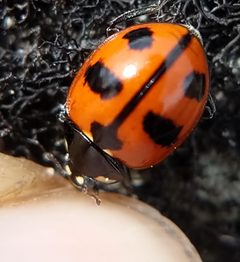
Coccinella alta is a small lady beetle in the Coccinellidae, first described by W.J. Brown in 1962. It is native to western North America, with confirmed records from Alberta, Utah, Colorado, and California. measure approximately 4.80–5.30 mm in length and display distinctive black and pale coloration patterns on the , pronotum, and . The species appears to be associated with high-elevation or montane , as suggested by its specific epithet and .

Pronunciation
How to pronounce Coccinella alta: /kɔk.sɪˈnɛl.lə ˈæl.tə/
These audio files are automatically generated. While they are not always 100% accurate, they are a good starting point.
Identification
Most reliably identified by the specific spot pattern: two black spots on each (four total), combined with the black bearing pale spots and the pronotum with black margin plus pale and spots. The small size (under 5.5 mm) and western North American distribution help narrow identification. Similar such as Coccinella septempunctata (seven-spotted) and Coccinella novemnotata (nine-spotted) have more numerous elytral spots and different pronotal patterns. Coccinella transversoguttata has connected spots forming transverse bars. Specimens should be examined under magnification for confident identification.
Images
Distribution
Western North America. Documented from Alberta (Canada), Utah, Colorado, and California (United States). GBIF records also indicate presence in British Columbia, Canada. The appears restricted to montane or high-elevation regions of the Rocky Mountains and adjacent ranges.
Similar Taxa
- Coccinella septempunctataSeven-spotted lady beetle has seven elytral spots (three on each wing cover plus one at the scutellum) rather than four, and white pronotal 'lapels' only at the corners rather than more extensive pale markings.
- Coccinella novemnotataNine-spotted lady beetle has up to nine elytral spots and a complete white pronotal 'collar' from corner to corner, unlike the black margin of C. alta.
- Coccinella transversoguttataTransverse lady beetle has elytral spots connected to form horizontal bars between the 'shoulders,' not discrete round spots.
Sources and further reading
- BugGuide
- Wikipedia
- GBIF taxonomy match
- iNaturalist taxon
- A Mural Like No Other | Bug Squad
- Bug Eric: "Zombie Ladybugs"
- Tabloid Sensationalism Aside, Lady Bugs Are Still Fascinating
- Bug Eric: ID Tip: Seven-spotted or Nine-spotted Lady Beetle?
- Acta Biologica Sibirica signs with Pensoft and moves to ARPHA | Blog
- Limb Regeneration in Lady Beetles: Product of Selection or Developmental Byproduct?