
Anamorphidae
Strohecker, 1953
Genus Guides
6Anamorphidae is a of small fungus-feeding beetles in the superfamily Coccinelloidea, containing over 175 extant across approximately 36 . The family was separated from Endomychidae by Robertson et al. (2015) based on morphological and molecular evidence. Members are obligate consumers of fungal spores in both and larval stages. A distinctive feature of the family is the presence of debris-cloaking in larvae—a unique defensive strategy among Coccinelloidea that has evolved only once in this lineage.
Pronunciation
How to pronounce Anamorphidae: //ænəˈmɔːrfɪdiː//
These audio files are automatically generated. While they are not always 100% accurate, they are a good starting point.
Identification
Distinguished from Endomychidae by laterally broadly closed mesocoxal cavities versus narrowly open or closed cavities in Endomychidae. Anamorphidae possess 10-segmented . The contains smaller-bodied compared to Endomychidae and Coccinellidae. Larval debris-cloaking , where present, is unique to this family within Coccinelloidea.
Images
Appearance
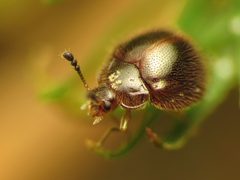
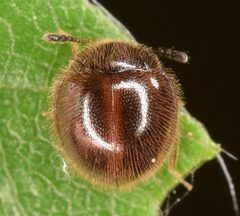
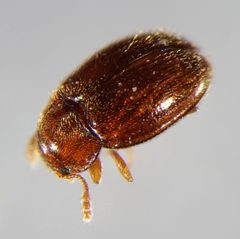
Small-bodied beetles with 10-segmented and laterally broadly closed mesocoxal cavities. The latter character serves as a key diagnostic feature separating Anamorphidae from the closely related Endomychidae. Body size is generally smaller compared to other coccinelloid . Larvae of some construct debris coverings using environmental materials for concealment.
Habitat
Predominantly surface-dwelling in environments where fungal growth occurs. Specific microhabitat associations vary by and region.
Distribution
Worldwide distribution for extant . Fossil record includes mid-Cretaceous Kachin amber from Myanmar and Eocene Baltic and Bitterfeld amber. Extinct Palaeosymbius known from Late Cretaceous Burmese amber.
Diet
Obligate fungivores; both and larvae feed exclusively on fungal spores.
Life Cycle
Larval development includes debris-cloaking in at least two (Catapotia and one other), where larvae conceal themselves with collected environmental material to avoid detection.
Behavior
Debris-cloaking: larvae of certain actively collect and apply environmental debris to their bodies for camouflage and protection. This defensive strategy has been reported in only two genera within the and nowhere else in the superfamily Coccinelloidea.
Ecological Role
Fungal spore consumers; contribute to nutrient cycling in fungal through spore .
Human Relevance
Minimal direct economic or agricultural significance. Historical specimens from 60+ year old collections have contributed to understanding of regional biodiversity, as demonstrated by studies of the Bechyné collection at the Royal Belgian Institute of Natural Sciences.
Similar Taxa
- EndomychidaeFormerly included within Endomychidae; separated by Robertson et al. (2015). Distinguished by mesocoxal cavity structure: Anamorphidae have laterally broadly closed cavities, Endomychidae have narrowly open or closed cavities. Endomychidae also exhibit multiple defensive strategies including and aposematic coloration, unlike Anamorphidae.
- CoccinellidaeBoth in Coccinelloidea. Coccinellidae are generally larger-bodied with diverse defensive strategies including , aposematic coloration, and gregarious . Anamorphidae are smaller and exhibit debris-cloaking instead.
More Details
Taxonomic History
Elevated to status from Endomychidae by Robertson et al. (2015) based on phylogenetic analyses. The family contains approximately 36 extant and over 175 described .
Fossil Record
Sparse but significant fossil record. Extinct Symbiotes and additional extinct genera known from Eocene Baltic and Bitterfeld amber. Extinct genus Palaeosymbius from Late Cretaceous Burmese amber represents early lineage. Newly described Cretaceous genus Yassibum from Kachin amber shows affinity to Anamorphidae.
Defensive Strategy Evolution
Debris-cloaking in Anamorphidae represents a single evolutionary origin of this defensive mechanism, contrasting with larger-bodied coccinelloid where multiple independent defensive strategies evolved. The small body size of Anamorphidae may have favored this cryptic strategy over active chemical or behavioral defenses.
Sources and further reading
- BugGuide
- Wikipedia
- GBIF taxonomy match
- iNaturalist taxon
- NCBI Taxonomy
- Catalogue of Life
- An updated checklist of Endomychidae and Anamorphidae (Coleoptera: Coccinelloidea) from El Salvador, with additional new records from the Neotropical region
- The debris-cloaking larva of Catapotia laevissima and the origin of defensive strategies in Anamorphidae and other Coccinelloidea (Coleoptera)
- An unusual Cretaceous beetle with affinity to Anamorphidae (Coleoptera: Coccinelloidea).