
Enoclerus sphegeus
(Fabricius, 1787)
Red-bellied Clerid
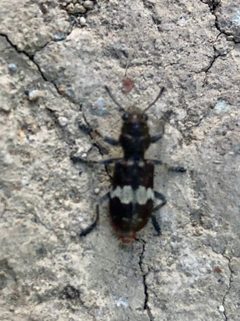
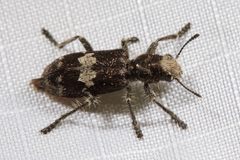
Enoclerus sphegeus, commonly known as the red-bellied clerid, is a of checkered beetle in the Cleridae. It is found in Central America and North America, including Alberta, Canada. The species is a significant of bark beetles, particularly the mountain pine beetle (Dendroctonus ponderosae) and Ips species. Larval development is variable, with individuals completing either two or three stadia depending on prey size consumed during the first stadium. The species pupates underground.
Pronunciation
How to pronounce Enoclerus sphegeus: /ˌɛn.ɔˈklɛr.əs ˈsfɛdʒ.i.əs/
These audio files are automatically generated. While they are not always 100% accurate, they are a good starting point.
Images
Habitat
Associated with lodgepole pine slash and dead coniferous wood. are found on freshly fallen or recently dead trees, including ponderosa pine and other pine . The species inhabits forested areas where bark beetle are present.
Distribution
Central America and North America. Documented in Alberta, Canada, and the western United States including Colorado. GBIF records indicate presence in Middle America and North America.
Diet
of bark beetle larvae and . Prey includes mountain pine beetle (Dendroctonus ponderosae), Ips pini, and Ips perroti. also kill and consume various other small insects found on dead wood.
Host Associations
- Dendroctonus ponderosae - preyLarvae are of D. ponderosae larvae and ; a major agent
- Ips pini - preyMost aggressive of Ips in lodgepole pine slash in Alberta
- Ips perroti - preySignificant in bark beetle complex
Life Cycle
Larval development involves a variable number of stadia: larvae fed small prey typically complete three stadia, while those fed medium or large prey usually pass through two stadia. The number of stadia is determined by the amount of food consumed during the first stadium. Larvae fed small prey have longer feeding periods but shorter prepupal periods. Second-instar larvae destined to complete two stadia have distinctly wider capsules than those completing three stadia. occurs underground.
Behavior
are active on dead wood surfaces. Larvae are aggressive predators within bark beetle galleries. The has been described as the most aggressive and responsible for the greatest among predators in bark beetle complexes.
Ecological Role
Important agent of bark beetles, particularly the mountain pine beetle. by E. sphegeus larvae on D. ponderosae larvae and represents a significant natural mortality factor for this economically important forest pest. The is considered a beneficial in forest .
Human Relevance
Valued as a natural agent for destructive bark beetles, especially the mountain pine beetle which damages pine forests. Checkered beetle abundance is considered an indicator of forest health.
Similar Taxa
- Enoclerus moestusFound in same on freshly-cut pine logs; smaller and less commonly encountered than E. sphegeus
- Enoclerus leconteiAnother Enoclerus found on dead wood; more cryptically colored rather than having the distinctive red-bellied appearance
- Thanasimus undulatusSmall clerid present in same bark beetle complexes but rarely encountered; less aggressive than E. sphegeus
More Details
Predator Efficacy
In studies of lodgepole pine slash in Alberta, E. sphegeus was the most important found with of Ips bark beetles, responsible for greater than all other predators combined including dipteran, hemipteran, and acarine .
Developmental Plasticity
The variable number of larval stadia (two or three) represents a developmental plasticity that allows larvae to adjust their growth trajectory based on food availability, a trait that may enhance survival in environments with unpredictable prey sizes.
Sources and further reading
- BugGuide
- Wikipedia
- GBIF taxonomy match
- iNaturalist taxon
- Bug Eric: Beetle Bonanza
- Cleridae | Beetles In The Bush | Page 2
- Orange-banded checkered beetle | Beetles In The Bush
- Archives | Beetles In The Bush
- predator avoidance | Beetles In The Bush | Page 7
- PREY CONSUMPTION AND VARIATIONS IN LARVAL BIOLOGY OF ENOCLERUS SPHEGEUS (COLEOPTERA: CLERIDAE)
- The Bark Beetle Complex Associated with Lodgepole Pine Slash in Alberta: Part III—Notes on the Biologies of Several Predators with Special Reference to Enoclerus sphegeus Fab. (Coleoptera: Cleridae) and Two Species of Mites