
Enoclerus lecontei
(Wolcott, 1910)
blackbellied clerid
Enoclerus lecontei is a predatory checkered beetle ( Cleridae) specialized in hunting bark beetles. It is found in North and Central America, with well-documented in western North America where it serves as a significant of the western pine beetle (Dendroctonus brevicomis). The has been extensively studied for its potential as a agent against forest pest beetles.
Pronunciation
How to pronounce Enoclerus lecontei: //ˌɛn.oʊˈklɛr.əs ləˈkɒn.taɪ//
These audio files are automatically generated. While they are not always 100% accurate, they are a good starting point.
Identification
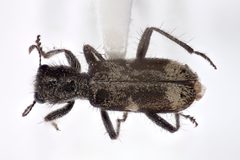
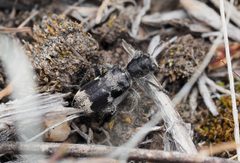
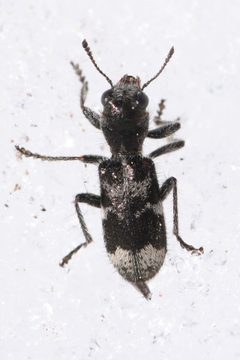
Distinguished from congeneric by cryptic coloration—described as camouflage-colored rather than brightly patterned like many other Enoclerus species. The relatively drab appearance contrasts with the orange-banded or boldly marked patterns seen in relatives such as E. ichneumoneus. Specific diagnostic characters beyond coloration are not documented in available sources.
Images
Habitat
Associated with pine forests where bark beetle prey occurs. Found on dead or dying pine trees infested by bark beetles, particularly in areas with western pine beetle activity.
Distribution
North America and Central America. Specific records include British Columbia, Canada, and western North American regions where western pine beetle is present.
Diet
Specialized of bark beetles. Larvae consume mature bark beetle larvae—at least one per instar required for development, with up to seven consumed per instar. consume bark beetle adults, with individuals eating 44–158 prey beetles over their lifespan.
Host Associations
- Dendroctonus brevicomis - preywestern pine beetle; primary documented prey in studies
Life Cycle
undergo distinctive color changes during development, used to determine age. Three larval instars: first instar 8–15 days, second 5–8 days, third 19–35 days. All larval instars orange-red; third instar turns purple 4–6 days after molting. Third instar feeds for only 4–11 days, then enters highly mobile, non-feeding stage for remainder of stadium. Pupal stage 9–11 days. lifespan 36–114 days.
Behavior
Third instar larvae exhibit a distinctive behavioral shift: after brief feeding period, become highly mobile and non-feeding for extended duration. Larval size varies according to amount of food consumed. Mating habits, oviposition , and feeding behavior described in detailed studies.
Ecological Role
of bark beetles, particularly the western pine beetle—a significant forest pest. Functions as a natural agent in pine forest . Potential value in programs for bark beetle suppression.
Human Relevance
Studied extensively for potential against western pine beetle and other bark beetle pests. No documented negative impacts on human activities.
Similar Taxa
- Enoclerus ichneumoneusBoth in Enoclerus and share bark beetle , but E. ichneumoneus has conspicuous orange band across and elongate scutellum making it visually distinctive; E. lecontei is cryptically colored
- Other Enoclerus speciesMany exhibit bright, boldly patterned coloration (often orange/red/black) and potential mimicry of velvet ants; E. lecontei lacks these aposematic features
More Details
Research significance
Among the most thoroughly studied clerid due to research on western pine beetle . Detailed laboratory studies documented precise stadium durations, feeding requirements, and behavioral transitions.
Coloration ecology
Unlike many with bright warning coloration or mimicry of hymenopterans, E. lecontei exhibits cryptic coloration. This has been interpreted as evidence for visual pressure selecting for camouflage rather than aposematism in this .