
Trirhabda geminata
Horn, 1893
Encelia Leaf Beetle
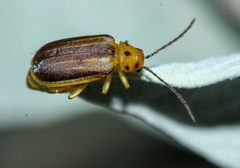
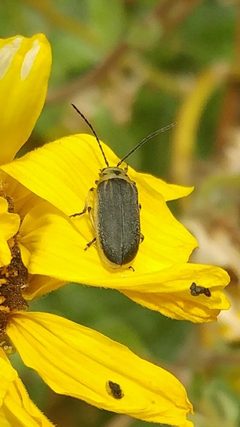
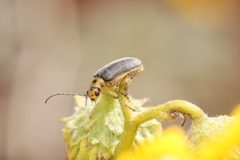
Trirhabda geminata is a skeletonizing leaf beetle in the Chrysomelidae, commonly known as the Encelia leaf beetle. It is a herbivore strongly associated with brittlebush (Encelia farinosa) and related Encelia in the Asteraceae. The is , with emerging in spring to feed, mate, and oviposit on foliage. Larvae feed gregariously on leaves, passing through three instars before pupating in soil. The species is notable for accumulating hydroxylated anthraquinones (chrysophanol and chrysazin) through apparent de novo biosynthesis, as these compounds are absent from its host plant and retained rather than excreted.
Pronunciation
How to pronounce Trirhabda geminata: /tɹɪˈræbdə ˌdʒɛmɪˈneɪtə/
These audio files are automatically generated. While they are not always 100% accurate, they are a good starting point.
Images
Habitat
Associated with desert and aridland supporting its plants, particularly brittlebush (Encelia farinosa). Laboratory studies utilized plants from coastal southern California and Baja California region, suggesting these areas represent core habitat.
Distribution
Central America and North America. Specific records include coastal southern California and Baja California, Mexico based on plant collection locations for laboratory studies.
Seasonality
emerge in spring; with one per year.
Diet
herbivore feeding on leaf tissue of Encelia (Asteraceae). Optimal are Encelia farinosa and Encelia californica, with significantly reduced survival and development on Bahiopsis parishii, Bahiopsis laciniata, and Viguiera deltoidea. No survival to adulthood was observed on Viguiera deltoidea in laboratory conditions.
Host Associations
- Encelia farinosa - primary brittlebush; optimal with 83% survival to adulthood and shortest larval development time (14.9 days)
- Encelia californica - near-optimal with 80% survival and 15.8 day larval development
- Encelia actoni - potential survival and development possible but suboptimal
- Bahiopsis parishii - poor reduced survival and extended development time
- Bahiopsis laciniata - poor extended larval development time (22.3 days)
- Viguiera deltoidea - unsuitable no survival to adulthood observed
Life Cycle
(one per year). emerge in spring, feed on foliage, mate, and oviposit on host plants. hatch into larvae that pass through three instars, feeding gregariously on host leaves. occurs in soil. Laboratory rearing on Encelia farinosa at 25°C yielded larval development times of approximately 15 days.
Behavior
Larvae feed gregariously on leaves. demonstrate feeding preference for optimal host in choice tests. Anthraquinone levels remain stable during starvation, indicating retention of these compounds rather than metabolic turnover or .
Ecological Role
Herbivore specializing on brittlebush and related desert composites. Potential to influence plant through defoliation, though natural densities and -level impacts have not been quantified.
Human Relevance
Potential agent or pest of ornamental and native Encelia plantings. Laboratory rearing methods have been developed for research purposes.
Similar Taxa
- Trirhabda bachariduscongeneric leaf beetle with similar skeletonizing feeding habit; distinguished by association with Baccharis halimifolia rather than Encelia
More Details
Chemical ecology
Accumulates hydroxylated anthraquinones (chrysophanol and chrysazin) in , larvae, and through apparent de novo biosynthesis. These compounds are absent from the plant Encelia farinosa and are not detected in , indicating the beetle produces and retains these compounds rather than sequestering them from diet. Biological functions remain under investigation.
Research significance
Serves as a model organism for studying herbivore-plant interactions, plant chemistry effects on insect performance, and de novo biosynthesis of secondary metabolites in leaf beetles.
Sources and further reading
- BugGuide
- Wikipedia
- GBIF taxonomy match
- iNaturalist taxon
- NCBI Taxonomy
- Cimbicidae | Beetles In The Bush
- Goldenrod Leaf Miner | Beetles In The Bush
- Heliconiidae | Beetles In The Bush
- Anthraquinones in the Leaf Beetle Trirhabda geminata (Chrysomelidae)
- Biology and Laboratory Development of Trirhabda geminata (Coleoptera: Chrysomelidae) on the Composite, Encelia farinosa
- Potential Host Plants ofTrirhabda geminata(Coleoptera: Chrysomelidae): Impacts on Survival, Development, and Feeding