
Altica bimarginata
Say, 1824
willow flea beetle
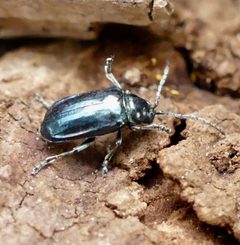
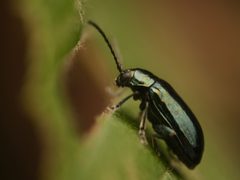
Altica bimarginata is a small, shiny blue flea beetle in the Chrysomelidae, commonly known as the willow flea beetle. It measures 5–6 mm in length and 2–3 mm in width. The is distributed across North America and Central America and is frequently associated with willow plants (Salix ). Three are recognized: A. b. bimarginata, A. b. labradorensis, and A. b. plicipennis. A neotype was designated for this species due to the loss of the original .
Pronunciation
How to pronounce Altica bimarginata: //ˈæltɪkə ˌbaɪmɑrdʒɪˈneɪtə//
These audio files are automatically generated. While they are not always 100% accurate, they are a good starting point.
Identification
Shiny blue coloration distinguishes this from many other Altica. Body length 5–6 mm, width 2–3 mm. Costate (ridged) characteristic of the costate species group within Altica. Identification to species level may require examination of male and female genitalia; keys for males and females are available in taxonomic revisions. The three (bimarginata, labradorensis, plicipennis) are distinguished by geographic distribution and subtle morphological differences.
Images
Habitat
Associated with willow-dominated environments including riparian zones, floodplains, and sand deposits along rivers. In Missouri, observed on sand plains deposited by flooding, where willows colonize edges of open sand .
Distribution
North America north of Mexico and Central America. A. b. labradorensis occurs in Labrador. Records from the United States include Missouri, with observations in Holt County and other northwestern Missouri localities.
Diet
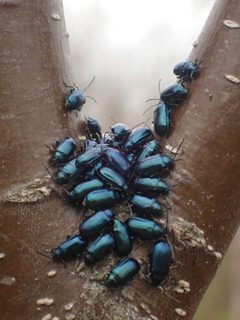
feed on willow foliage (Salix spp.). Observations indicate preference for smaller willow plants (1–3 feet in height), with larger plants relatively untouched. Heavy adult feeding damage has been documented, though larval presence on foliage is not always detected.
Host Associations
- Salix - herbivoreprimary plant; feed on foliage
Life Cycle
Larvae not consistently found on foliage despite heavy feeding, suggesting possible subterranean or stem-boring larval habits typical of flea beetles, though specific details for this are not well documented.
Behavior
congregate heavily on smaller willow plants. When disturbed, flea beetles in this typically jump using enlarged hind .
Ecological Role
Herbivore in willow-dominated riparian . Part of the early successional fauna colonizing disturbed sand deposits and floodplain .
Human Relevance
Minor potential as a pest of willow plantings; heavy feeding can cause noticeable defoliation of young willows.
Similar Taxa
- Altica subplicataAlso associated with willow in Missouri; A. bimarginata distinguished by shiny blue coloration and costate
- Other Altica speciesMany Altica are similar in size and habit; accurate identification requires examination of genitalia or reference to geographic distribution and association