
Colaspis melaina
Blake, 1974
Grape colaspis
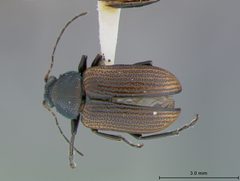
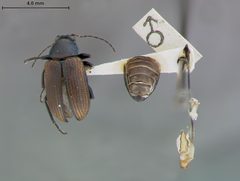
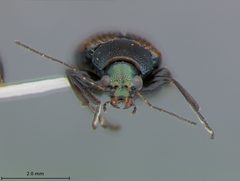
Colaspis melaina is a of leaf beetle in the Chrysomelidae, commonly known as the grape colaspis. It is recognized as an early-season pest of soybeans in the southern United States, particularly in the lower Mississippi Valley region including Arkansas, Louisiana, Mississippi, and Tennessee. The species is one of several Colaspis beetles associated with agricultural crops, and its larvae feed on plant roots while feed on foliage.
Pronunciation
How to pronounce Colaspis melaina: /kəˈlæspɪs mɪˈlaɪnə/
These audio files are automatically generated. While they are not always 100% accurate, they are a good starting point.
Identification
Colaspis melaina belongs to a of small to medium-sized leaf beetles with oval or oblong bodies. -level identification within Colaspis requires examination of genitalia and other microscopic features; external alone is generally insufficient for reliable differentiation from such as Colaspis brunnea and other grape colaspis species.
Images
Habitat
Agricultural landscapes, particularly soybean fields. Associated with early-planted soybean crops in the southern United States where it occurs as part of an early-season pest complex.
Distribution
North America. Documented as a pest in Arkansas, Louisiana, Mississippi, and Tennessee within the southern United States.
Seasonality
Early-season pest in soybean production systems. Activity coincides with early planting periods in southern U.S. agriculture, typically spring through early summer.
Diet
Larvae feed on roots of plants. feed on foliage.
Host Associations
- Glycine max - pestSoybean. Documented as an early-season pest in southern U.S. soybean production.
- Vitis - associatedGrape. 'grape colaspis' suggests association, though specific records for C. melaina require verification.
Behavior
Part of an early-season pest complex in southern soybean systems. Neonicotinoid have been observed to effectively control this and other early-season pests.
Ecological Role
Herbivore. Agricultural pest that contributes to yield reduction in soybean when present at damaging levels.
Human Relevance
Agricultural pest of economic significance in southern U.S. soybean production. Subject of research evaluating for . Meta-analysis of field trials demonstrated that neonicotinoid seed treatments provided yield benefits in Louisiana and Mississippi when this and other early-season pests were present.
Similar Taxa
- Colaspis brunneaAnother grape colaspis with similar and agricultural pest status. External features do not reliably distinguish the two species.
- Cerotoma trifurcataBean leaf beetle, another early-season pest of soybeans in the same region. Different but similar ecological role and timing in pest management programs.
More Details
Economic impact research
A 10-year meta-analysis of 170 field trials in Arkansas, Louisiana, Mississippi, and Tennessee found that neonicotinoid provided statistically significant yield increases in soybeans where early-season pests including grape colaspis were present. Yield improvements of 70-203 kg/hectare were documented, with economic benefits in 4 of 10 years studied.