
Pachybrachis bivittatus
(Say, 1824)
Say's Two-striped Pachy
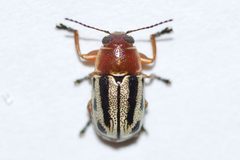
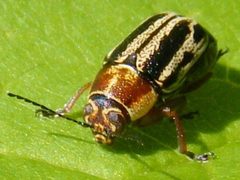
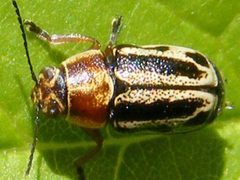
Pachybrachis bivittatus is a case-bearing leaf beetle (Chrysomelidae: Cryptocephalinae) found in Central and North America. emerge in late May, feed on willow foliage, and reproduce from June to July. Larvae are case-bearing and feed on dead willow leaves in leaf litter, lacking the ability to climb plants. They overwinter in sealed cases as late-instar larvae and pupate the following spring.
Pronunciation
How to pronounce Pachybrachis bivittatus: //ˈpækɪˌbreɪ.kɪs ˌbaɪ.vɪˈteɪ.təs//
These audio files are automatically generated. While they are not always 100% accurate, they are a good starting point.
Images
Habitat
inhabit willow foliage. Larvae occur in leaf litter containing dead willow leaves, where they feed and develop.
Distribution
Central America and North America; recorded from Alberta, Canada.
Seasonality
active from late May through summer; oviposition June–July. Larvae present from summer through late autumn, overwinter in sealed cases, and pupate the following spring (likely early May).
Diet
feed on willow (Salix) leaves. Larvae feed on dead willow leaves in leaf litter.
Host Associations
- Salix - food plant and larval food sourcelarvae feed on dead leaves in litter, on live foliage
Life Cycle
laid June–July. First instar larvae possess egg bursters on meso- and for . Larvae progress through instars feeding in leaf litter, reach or final instar by late autumn, then seal their case and overwinter in this state. occurs the following spring, probably in early May.
Behavior
Larvae are incapable of climbing plants and remain in leaf litter. Larvae construct and seal a protective case for .
Similar Taxa
- Pachybrachis peccanscongeneric with similar ; both described in same study, sharing willow association and case-bearing larval
- Melanoplus bivittatusshares similar 'Two-striped' and partial distribution overlap, but belongs to entirely different order (Orthoptera: Acrididae) and is a , not a
Sources and further reading
- BugGuide
- Wikipedia
- GBIF taxonomy match
- iNaturalist taxon
- Grasshoppers of Colorado
- Twostriped Grasshopper
- Grasshoppers of Colorado
- Grasshoppers of Colorado
- Grasshopper Links
- Grasshoppers of Colorado
- THE EGGS AND LARVAE OF PACHYBRACHIS PECCANS AND P. BIVITTATUS, WITH A KEY TO THE KNOWN IMMATURE STAGES OF THE NEARCTIC GENERA OF CRYPTOCEPHALINAE (COLEOPTERA: CHRYSOMELIDAE)