
Diachus
J.L.LeConte, 1880
case-bearing leaf beetles
Species Guides
4- Diachus auratus(bronze leaf beetle)
- Diachus catarius
- Diachus chlorizans
- Diachus subopacus
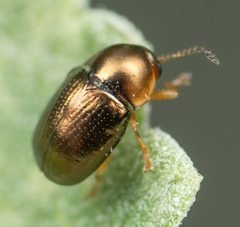
Diachus is a of case-bearing leaf beetles in the Chrysomelidae. The genus contains approximately 10 described , with a distribution centered in the Americas. Members of this genus are characterized by their case-bearing habit, where larvae construct protective cases from fecal material and . The genus was established by J.L. LeConte in 1880.
Pronunciation
How to pronounce Diachus: //ˈdaɪəkəs//
These audio files are automatically generated. While they are not always 100% accurate, they are a good starting point.
Identification
are small leaf beetles with compact, somewhat convex bodies. The can be recognized by the combination of: antennal insertions visible from above, pronotum without lateral marginal carinae, and with distinct punctation. -level identification requires examination of male genitalia and subtle differences in coloration and punctation patterns. Diachus species generally lack the metallic brilliance seen in some related chrysomelid genera, though Diachus auratus is known as the 'bronze leaf beetle'.
Images
Habitat
in this are associated with herbaceous vegetation and low-growing plants in open . Based on collection records and observations, they occur in grasslands, meadows, and open woodland edges. Specific plant associations remain poorly documented for most species.
Distribution
Primarily distributed in the Americas. Records indicate presence in North America (United States, Canada) and Central America (Colombia). The appears to be most diverse in the eastern and central United States, with several described by LeConte and Suffrian based on North American material.
Seasonality
have been observed primarily during the growing season, with most records from spring through early fall (approximately April–September in temperate regions). Specific varies by and latitude.
Life Cycle
Larvae are case-bearers, constructing portable protective cases from their own fecal material mixed with . This is characteristic of the Cryptocephalinae, to which Diachus belongs. The case is carried throughout larval development and attached to the substrate during . Detailed information is not available for most .
Behavior
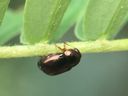
are active on vegetation and have been observed on leaves and stems. When disturbed, they may drop to the ground or tuck their legs close to the body, relying on their convex shape and protective coloration for defense. Larval is constrained by the case-bearing habit, limiting mobility and requiring case construction and maintenance.
Ecological Role
As herbivores, larvae and likely contribute to nutrient cycling through leaf consumption. Their case-bearing habit may provide some protection from and . Specific ecological impacts are not well documented.
Human Relevance
Limited direct significance. Diachus auratus, the 'bronze leaf beetle,' is occasionally noted in entomological collections. The is not known to be an agricultural pest, though minor feeding on ornamental or crop plants may occur. Some are collected for scientific study and biodiversity documentation.
Similar Taxa
- CryptocephalusAlso case-bearing leaf beetles in Chrysomelidae, but Cryptocephalus typically has more rounded, strongly convex bodies and often brighter coloration. Antennal insertions and pronotal structure differ.
- BassareusSimilar compact body form, but Bassareus often have more elongate bodies and different antennal proportions. Male genitalia provide definitive separation.
- PachybrachisSmall leaf beetles with similar habits, but Pachybrachis lacks the case-bearing larval habit and has different tarsal and antennal characteristics.
More Details
Taxonomic History
The was established by John Lawrence LeConte in 1880. Several were originally described in other genera (notably Cryptocephalus) and later transferred to Diachus based on morphological studies. The genus has remained relatively stable in composition, with approximately 10 species recognized for over a century.
Research Needs
Most lack modern taxonomic revisions. plant associations, detailed distribution records, and stages are poorly known for the majority of species. Molecular phylogenetic studies may clarify relationships within the and with related cryptocephaline genera.