
Oulema palustris
Blatchley, 1913
Marsh Cereal Leaf Beetle
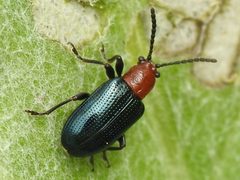
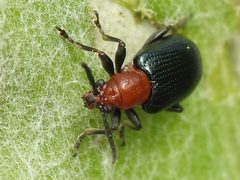
Oulema palustris is a North American leaf beetle in the Chrysomelidae. The is a herbivore associated with thistles, with larvae functioning as leaf miners and feeding externally on foliage. The specific epithet 'palustris' refers to marshy , though the species' exact habitat preferences require further documentation.
Pronunciation
How to pronounce Oulema palustris: /uˈleː.ma paˈluː.stris/
These audio files are automatically generated. While they are not always 100% accurate, they are a good starting point.
Images
Distribution
North America. Records indicate presence in Canada (Ontario, Québec) and the United States. The ' range appears to extend across temperate eastern North America, though precise boundaries are poorly documented.
Diet
Larvae are leaf miners of Cirsium horridulum (yellow thistle). feed on thistles (Cirsium spp.).
Host Associations
- Cirsium horridulum - larval leaf mining
Life Cycle
Larvae mine leaves of thistles. Prior to , larvae burrow into soil. emerge and feed on thistle foliage.
Ecological Role
Herbivore; . As a thistle feeder, the contributes to natural herbivore pressure on native thistle .
Similar Taxa
- Oulema melanopusSimilar size and preference (grasslands, agricultural areas), but O. melanopus is a significant cereal crop pest feeding on grasses (Poaceae) rather than thistles. O. palustris can be distinguished by its association with Cirsium and lack of economic impact on cereals.
- Oulema gallaecianaAnother with similar , but with different plant associations (grasses vs. thistles) and geographic distribution patterns.
More Details
Taxonomic Note
The specific epithet 'palustris' (Latin: 'of the marsh') suggests wetland associations, though this has not been explicitly documented in available literature. The may have been described from marsh-associated thistle .
Research Gaps
Most aspects of this ' remain undocumented, including detailed , precise requirements, seasonal , and full geographic range. Available information derives primarily from larval records and scattered collection data.
Sources and further reading
- BugGuide
- Wikipedia
- GBIF taxonomy match
- iNaturalist taxon
- Gall darn it! Gall insects on hickory, oak, and elm, Phylloxera caryaecaulis, Andricus palustris, Colopha ulmicola — Bug of the Week
- Braconidae | Beetles In The Bush
- April | 2023 | Beetles In The Bush
- Uncategorized | Blog - Part 29
- Sunday scarab: Phileurus valgus | Beetles In The Bush