
Microtheca
Ehrenberg, 1838
leaf beetles
Species Guides
2- Microtheca ochroloma(Yellow-margined Leaf Beetle)
- Microtheca picea
Microtheca is a of leaf beetles in the Chrysomelidae, Chrysomelinae. The genus contains several economically important agricultural pests, particularly of Brassicaceae crops. The most extensively studied include M. ochroloma (yellowmargined ) and M. punctigera, both of which are oligophagous on cruciferous plants. These beetles are native to the Neotropics but have become significant pests in organic agriculture systems where synthetic are restricted.
Pronunciation
How to pronounce Microtheca: //ˌmaɪ.kɹoʊˈθiː.kə//
These audio files are automatically generated. While they are not always 100% accurate, they are a good starting point.
Identification
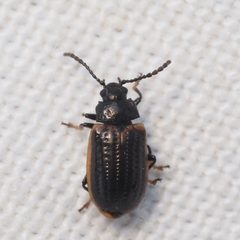
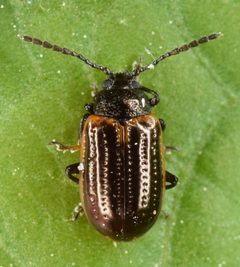
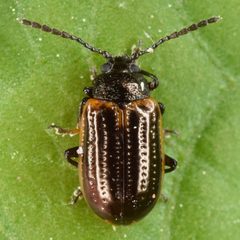
Small to medium-sized leaf beetles with typical chrysomeline . M. ochroloma is distinguished by yellow margins on the . within the require careful examination of genitalia and elytral punctation patterns for definitive identification. M. ochroloma and M. punctigera are frequently confused in regions where their ranges overlap; accurate identification requires dissection or molecular methods.
Images
Habitat
Agricultural fields and cultivated areas planted with Brassicaceae crops. thrive in organic farming systems with reduced pressure. Beetles shelter in closed leaves of cabbage and related crops.
Distribution
Neotropical native range including Argentina, Brazil, Chile, and Uruguay. M. ochroloma has been introduced to the southeastern United States (Louisiana, Alabama, Florida) where it has become established as a pest of organic crucifer production. M. punctigera is documented in Brazilian states of Rio de Janeiro, Rio Grande do Sul, and Paraná.
Seasonality
Multivoltine with continuous breeding under favorable conditions. In warm conditions (~25°C), M. ochroloma completes its in less than one month. M. punctigera peak during winter periods in subtropical regions. An aestival has been reported for Microtheca in warmer climates.
Diet
Oligophagous, feeding exclusively on Brassicaceae. Strong preferences documented for turnip, mustard, and napa cabbage; cabbage and collard are less preferred. Larvae are voracious feeders and cause more damage than .
Host Associations
- Brassica oleracea var. capitata - cabbage; least preferred for survival in M. ochroloma
- Brassica oleracea var. acephala - collard; lowest for M. ochroloma
- Brassica juncea - mustard; strongly preferred
- Brassica rapa - turnip; most preferred for M. ochroloma
- Brassica pekinensis - Chinese cabbage
- Raphanus sativus - radish
- Raphanus raphanistrum - wild radish
- Nasturtium officinale - watercress
- Eruca sativa - arugula/rocket
Life Cycle
, four larval instars, prepupal, pupal, and stages. M. ochroloma: mean development from oviposition to adult 26.6 days on turnip, 27.5 days on cabbage. plant does not significantly affect development duration but strongly influences multi- and . M. punctigera: third instar larvae feed gregariously and produce abundant excrements.
Behavior
Larvae feed gregariously and are highly voracious. Both immatures and exhibit aggregated spatial distribution on plants. Small do not congregate; at higher densities, beetles move en masse in response to herbivory. Adults and larvae shelter in the interior of closed leaves. Males of M. punctigera are repelled by neem oil in multiple-choice assays.
Ecological Role
Major agricultural pest of Brassicaceae crops. Damage is primarily caused by larval feeding, which can result in complete crop devastation if control measures are not adopted. In organic systems, build rapidly due to absence of synthetic . Serves as prey for including the spined soldier bug (Podisus maculiventris).
Human Relevance
Significant economic pest in organic crucifer production. M. ochroloma is particularly problematic in the southeastern United States where organic vegetable production has expanded. Management relies on combining trap cropping (turnip and napa cabbage as border crops), cultural control (timely and residue removal), ( conservation and ), and limited use of OMRI-approved (spinosad, pyrethrins). No confirmed exist; researchers suggest one per plant as action threshold. Trap cropping can increase grower profits by approximately $232 per acre compared to standard practices.
Similar Taxa
- Phyllotreta spp.Flea beetles also feed on Brassicaceae; distinguished by enlarged hind for jumping and smaller body size
- Phyllotreta striolataStriped flea beetle shares and ; Microtheca are larger with different antennal structure and lack jumping hind legs
- Altica spp.Flea beetles with similar associations; distinguished by body shape and hind leg
- Podagrica spp.African flea beetles on Brassicaceae; geographic separation and morphological differences in and
More Details
Taxonomic note
The name Microtheca has been used in multiple kingdoms: for diatoms (), gastropod molluscs (synonym of Microthyca), and orchids (synonym of Cynorkis). The genus Microtheca Ehrenberg, 1838 is valid and distinct. Some sources cite Stål as author for M. ochroloma; the authorship requires verification.
Research applications
Volatile organic compounds attracting M. ochroloma to preferred have been identified and are being developed as lures for monitoring and management. Glutathione S-transferase activity varies 10-fold between host plants in M. ochroloma, suggesting metabolic mechanisms.
Insecticide susceptibility
M. ochroloma larvae are susceptible to esfenvalerate, carbaryl, and malathion in laboratory assays, though field efficacy data are limited. In organic systems, only spinosad and pyrethrins have demonstrated effectiveness among approved materials.
Sources and further reading
- BugGuide
- Wikipedia
- iNaturalist taxon
- NCBI Taxonomy
- Catalogue of Life
- Microtheca-ochroloma-on-cabbage - Entomology Today
- Microtheca ochroloma Archives - Entomology Today
- Yellowmargined Leaf Beetle: New Guide Offers Pest Management Tips for Organic Growers
- Trap Cropping May Offer Organic Growers an Alternative to Pesticides
- OCCURRENCE OF MICROTHECA PUNTIGERA (ACHARD) AND MICROTHECA SEMILAEVIS STAL IN FIVE HOSTS IN THE FIELD
- Repellent, antifeedant and insecticidal effects of neem oil on Microtheca punctigera
- The Biology and Ecology of the Yellowmargined Leaf Beetle, Microtheca Ochroloma Stal, (Coleoptera: Chrysomelidae) on Crucifers.
- Biology, Ecology, and Management of Microtheca ochroloma (Coleoptera: Chrysomelidae) in Organic Crucifer Production
- Population differences in water‐use efficiency of Eucalyptus microtheca seedlings under different watering regimes
- Effect of aqueous extract of Eucalyptus Microtheca on Acanthamoeba genotype T5, an in vitro study.