
Entomoscelis
Chevrolat in Dejean, 1836
Species Guides
1- Entomoscelis americana(red turnip beetle)
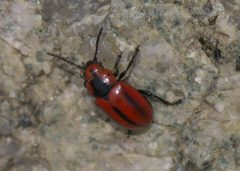
Entomoscelis is a of medium-sized leaf beetles in the Chrysomelidae, characterized by distinctive red with black markings. The genus comprises approximately 12 described distributed across the Holarctic region, with 11 species in the Palearctic and one species (E. americana, now synonymized with E. adonidis) in the Nearctic. range from 5–10 mm in length. Several species are associated with Brassicaceae plants, and some are recognized agricultural pests.
Pronunciation
How to pronounce Entomoscelis: /ɛnˌtoʊmoʊˈskɛlɪs/
These audio files are automatically generated. While they are not always 100% accurate, they are a good starting point.
Identification
Distinguished from similar leaf beetle by the combination of red with three black longitudinal vittae and medium body size (5–10 mm). The provides definitive -level identification; E. adonidis and related differ in aedeagus structure from other Chrysomelidae. Within the genus, species separation requires examination of male genitalia, particularly the and structure.
Images
Habitat
Associated with forest, forest-grassland, and grassland vegetation types. occur in low-altitude locations, with northern limited by climate and plant availability. In North America, E. adonidis (as E. americana) occupies the Western Cordillera and Interior Plains between 45°N and 68°N latitude.
Distribution
Holarctic distribution: 11 in the Palearctic region (Europe, Asia, North Africa) and one species in the Nearctic region (western North America). Specific species distributions include: E. adonidis from Portugal to the Russian Far East and northwestern North America; E. sacra from southeastern Europe through the Middle East to Iran; E. in North Africa from Morocco to Libya; E. berytensis in the Levant and adjacent regions; and several species to Central Asia and China.
Seasonality
of E. adonidis emerge from summer estivation () in early August. Oviposition occurs from mid-August to mid-October, with peak -laying approximately two weeks after . Activity patterns likely vary across the depending on local climate conditions.
Diet
Herbivorous, feeding on Brassicaceae. of E. adonidis have been confirmed to feed on Berteroa incana, Barbarea vulgaris, Sisymbrium officinale, Capsella bursa-pastoris, and Thlaspi arvense; larvae feed on Brassica campestris, B. napus, B. juncea, B. hirta, and various wild mustards. Larvae possess responsive to glucosinolates, sugars, and .
Host Associations
- Brassicaceae - primary and larvae feed on multiple including Brassica, Barbarea, Capsella, Sisymbrium, Thlaspi, and others
- Adonis vernalis - Ranunculaceae; confirmed as in cage studies for E. adonidis
Life Cycle
Complete with four larval instars. E. adonidis undergoes summer estivation () as , emerging in early August to reproduce. begins within 3 days of ; oviposition starts within 8 days and peaks at 2 weeks. are laid from mid-August to mid-October. Larval development occurs on plants, with S-shaped growth curves. site not explicitly documented but inferred to occur in soil or leaf litter based on related Chrysomelidae.
Behavior
exhibit strong fidelity; E. adonidis remains associated with host plant fragments even in the absence of green leaves. Both sexes mate multiple times beginning the first day after from estivation. The bright red and black coloration functions as aposematic (warning) coloration, advertising unpalatability or to . Larvae possess specialized for detecting host plant chemical cues including glucosinolates.
Ecological Role
Herbivore specializing on Brassicaceae; contributes to nutrient cycling through herbivory. Aposematic coloration suggests chemical defense acquisition, possibly through of plant glucosinolates or other secondary compounds. Serves as prey item for , though warning coloration may reduce pressure.
Human Relevance
E. adonidis (historically including E. americana, the red turnip ) is an agricultural pest of Brassica crops including turnips, rapeseed, and mustard. Larval feeding damages cotyledons and leaves; feeding also contributes to crop injury. Pest management recommendations include elimination of volunteer commercial mustards and cruciferous weeds in spring to prevent buildup. The ' temperature adaptations and plant specificity influence its pest status and geographic distribution in agricultural regions.
Similar Taxa
- Chrysomela populiSimilar red and black aposematic coloration with red and black markings; distinguished by association with Salicaceae rather than Brassicaceae, and by elytral pattern details
- HippuriphilaRelated chrysomelid with Holarctic distribution historically confused with Entomoscelis; distinguished by morphological characters including structure
Misconceptions
The American was historically described as distinct E. americana based on subtle morphological differences, but is now synonymized with the Eurasian E. adonidis. Earlier designations (E. adonidis caucasica, E. dorsalis bashkiriae) have been synonymized following statistical analysis showing geographic clinal variation rather than discrete subspecific differences.
More Details
Taxonomic history
The has undergone recent taxonomic revision. E. americana Brown, 1942 was synonymized with E. adonidis (Pallas, 1771). E. adonidis caucasica and E. dorsalis bashkiriae were synonymized with E. adonidis adonidis in 2021 based on statistical analysis of 782 specimens showing continuous geographic variation.
Sensory biology
Larval E. adonidis possess on the maxillary palps and with specialized responsive to glucosinolates, sugars, and . This differs from other crucifer-feeding insects in showing a multicellular response to glucosinolates rather than the typical single-cell detection system.
Sources and further reading
- BugGuide
- Wikipedia
- GBIF taxonomy match
- iNaturalist taxon
- NCBI Taxonomy
- Catalogue of Life
- Biology of Entomoscelis Chevrolat
- THE AMERICAN SPECIES OFENTOMOSCELISANDHIPPURIPHILA(COLEOPTERA, CHRYSOMELIDAE)
- REPRODUCTIVE CYCLES OF THE RED TURNIP BEETLE, ENTOMOSCELIS AMERICANA BROWN (COLEOPTERA: CHRYSOMELIDAE)
- Review of leaf beetles from the genus Entomoscelis (Coleoptera: Chrysomelidae) in Kazakhstan and Central Asia
- NATIVE HOST PLANTS OF THE LARVAE OF THE RED TURNIP BEETLE, ENTOMOSCELIS AMERICANA (COLEOPTERA: CHRYSOMELIDAE)
- THE RED TURNIP BEETLE, ENTOMOSCELIS AMERICANA (COLEOPTERA: CHRYSOMELIDAE): DISTRIBUTION, TEMPERATURE ADAPTATIONS, AND ZOOGEOGRAPHY
- On the quantitative criteria of subspecies in insects. Case study of Entomoscelis adonidis (Coleoptera: Chrysomelidae) in European Russia and the Caucasus
- THE SUITABILITY OF NINE SPECIES OF CRUCIFERAE AS HOSTS FOR THE LARVAE OF THE RED TURNIP BEETLE, ENTOMOSCELIS AMERICANA (COLEOPTERA: CHRYSOMELIDAE)
- GROWTH, DEVELOPMENT, AND SURVIVAL OF THE LARVAE OF THE RED TURNIP BEETLE,ENTOMOSCELIS AMERICANA(COLEOPTERA: CHRYSOMELIDAE), ONBRASSICA CAMPESTRISANDB.NAPUS(CRUCIFERAE)
- SOME ASPECTS OF GUSTATION IN THE LARVAL RED TURNIP BEETLE, ENTOMOSCELIS AMERICANA, RELATED TO FEEDING AND HOST PLANT SELECTION
- Figure 2 - Adaptive behavior of leaf beetles. 1 - The female of the herb leaf beetle <i> Chrysolina graminis </i> suspends the embryos from the underside of the narrow leaves of high wormwood, thus protecting them from the direct flow of sunlight (photo by S.I. Pavlov); 2 - A shield of exuvia and excrement (resting on the tail filaments above the back), like an umbrella, protects the larva of the beetle beetle from hard solar radiation (photo by V.N. Makarenkov); 3 - Climbing to the very top of the shoot of the fodder plant, the beetle <i> Lilioceris lilii </i> sucks out the juice and at the same time inspects the surroundings (photo by V.N. Makarenkov); 4 - Being programmed to consume only fragments of the host plant, the rape leaf beetle <i> Entomoscelis adonidis </i>, even in the absence of green leaves, prefers not to part with the host plant for a long time (photo by V.N. Makarenkov); 5 - Usually, in populations of rainbow leaf beetles (Donaciinae), the number of males is equal to the number of females, but, in certain situations, a disproportion may occur, in which there are 2 or 3 times more males (photo by V.N. Makarenkov); 6 - During mass breeding, the number of leaf beetles in clusters, for example, the flea <i> Phyllotreta atra </i>, can increase 2 or more times (in the picture, for example, 1 cm2 of horseradish leaf surface is fed on average by 4.5 ops). At this time, insects have to compete fiercely with each other because of the food resource (photo by O.V. Pavlova)
- Figure 2 - Protective adaptations and behavior of chorto- and dendrobionts: <i>1</i> - the beetle <i>Labidostomis humeralis</i> caught in the rain took a protective pose corresponding to the weather situation (photo by V. Dmitriev); <i>2</i> - the green color of the covers with bright metallic iridescence well hides the <i>Chrysolina menthastri</i> beetle from potential predators (photo by V.N. Makarenkov); <i>3</i> - wide "field" of dark red elytra in combination with black head, pronotum and legs - a reliable aposematic marker for the <i>Chrysomela populi</i> beetle (photo by V.N. Makarenkov); <i>4</i> - an even more effective warning signal is a combination of red "fields" and black spots and stripes on the integument of the beetle <i>Entomoscelis adonidis</i> (photo by V.N. Makarenkov); <i>5</i> - in case of a sudden appearance of a predator, the <i>Galeruca tanaceti</i> beetle, unable to escape urgently, secretes from the mouth opening a large drop of hemolymph, poisonous for enemies (photo by N.A. Berezin); <i>6</i> - brown-yellow elytra with black spots and mother-of-pearl tint successfully mask the beetle <i>Cassida nebulosa</i> among variegated grass (photo by OV Pavlova); <i>7</i> - the camouflage of the <i>Cassida vibex</i> beetle is so perfect that if the insect had no smell at all, it would be practically invulnerable to its enemies (photo by V.N. Makarenkov); <i>8<i/> - the integument of the body of the beetle <i>Cassida viridis<i/> is so flattened that even the outer edges of the pronotum and elytra do not bend upward (photo by K.V. Makarov)