
Entomoscelis americana
Brown, 1942
red turnip beetle
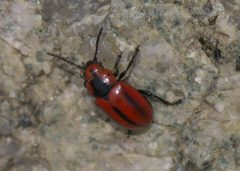
Entomoscelis americana is a leaf beetle in the Chrysomelidae, commonly known as the red turnip . It is native to North America, primarily distributed between 45° and 68° north latitude within the Western Cordillera and Interior Plains physiographic regions. The is associated with forest, forest-grassland, and grassland vegetation types. In 2020, it was synonymized with the Palearctic species Entomoscelis adonidis, though this relationship was historically disputed based on morphological differences in male genitalia.
Pronunciation
How to pronounce Entomoscelis americana: /ɛn.toʊ.moʊˈskɛ.lɪs əˌmɛr.ɪˈkæ.nə/
These audio files are automatically generated. While they are not always 100% accurate, they are a good starting point.
Identification
Historically distinguished from the Eurasian Entomoscelis adonidis by differences in the form of the and slight characters of color and , though these are now considered . Specific diagnostic features for field identification are not documented in available sources.
Images
Habitat
Associated with three vegetation types: forests, forest-grasslands, and grasslands. Occupies low altitude locations, with distribution restricted to lower elevations north of 60°N latitude by climate and plant abundance.
Distribution
North America, primarily within the Western Cordillera and Interior Plains physiographic regions between latitudes 45°N and 68°N. Present in Canadian provinces including Alberta, British Columbia, and Manitoba. Range limited eastward by plant abundance and southward by temperature adaptations.
Seasonality
emerge from estivation in early August. Oviposition occurs from mid-August to mid-October, with peak -laying approximately two weeks after initiation.
Diet
Larvae feed on leaves of cruciferous plants. Laboratory studies confirm suitability of Brassica campestris, B. napus, B. juncea, B. hirta, Capsella bursa-pastoris, Erucastrum gallicum, Sinapis arvensis, and Rorippa palustris. Rorippa palustris is considered the only normal native host plant in nature. likely feed on similar host plants, though specific adult diet is not documented.
Host Associations
- Rorippa palustris - larval only normal native plant in nature
- Brassica campestris - larval suitable in laboratory and field
- Brassica napus - larval suitable in laboratory
- Brassica juncea - larval suitable, including commercial mustard cultivars
- Brassica hirta - larval suitable, yellow mustard
- Capsella bursa-pastoris - larval suitable weed
- Erucastrum gallicum - larval suitable weed
- Sinapis arvensis - larval suitable weed
- Descurainia pinnata - larval marginally suitable in laboratory
- Descurainia richardsonii - larval marginally suitable in laboratory
- Lepidium densiflorum - larval marginally suitable in laboratory
- Erysimum cheiranthoides - larval marginally suitable, introduced
Life Cycle
Four larval instars with S-shaped growth curve. Larvae feed on plant leaves, then pupate in soil. undergo estivation, emerging in early August. begins within 3 days of ; oviposition starts within 8 days. -laying peaks within 2 weeks and continues through mid-October. stage not explicitly documented in available sources.
Behavior
mate multiple times, with copulation initiated on the first day after from estivation. Males transfer sufficient sperm during the first 8 days post-emergence to fertilize nearly all produced. Copulation and insemination stimulate increased egg output but are not required for initiation of or oviposition.
Ecological Role
Herbivore specializing on cruciferous plants. Larval feeding on native Rorippa palustris and various Brassica . influenced by plant abundance, which limits eastward range expansion.
Human Relevance
Considered a pest of cruciferous crops, particularly turnips and commercial mustard cultivars (Brassica juncea, B. hirta). Management recommendations include elimination of volunteer commercial mustards and cruciferous weeds in April and May to prevent build-up. Not a significant agricultural pest in modern crop systems based on available documentation.
Similar Taxa
- Entomoscelis adonidisHistorically considered distinct based on and slight color and differences, but synonymized in 2020; Palearctic distribution
- Other ChrysomelidaeGeneral similarity as leaf beetles, but specific distinguishing features for E. americana not documented in available sources
More Details
Taxonomic history
Originally described as distinct from Eurasian E. adonidis by W.J. Brown in 1942 based on morphological differences in male genitalia and minor color and characters. Synonymized with E. adonidis in 2020, though the original description noted no reason to believe the distributions were continuous.
Temperature adaptations
Eight specific temperature adaptations in and stages collectively limit southward range extension. Most eggs are laid at the lowest temperature regime tested (6-20°C, mean 12°C). Climate and plant abundance restrict the to low elevations north of 60°N latitude.
Reproductive output
Mean varies with conditions: 254±74 per female (1974, isolated), 273±47 eggs (1976, isolated), and 426±3 eggs (1974, grouped, 25 females per cage). Maximum recorded fecundity ranged from 622 to 696 eggs per female.
Sources and further reading
- BugGuide
- Wikipedia
- GBIF taxonomy match
- iNaturalist taxon
- NCBI Taxonomy
- Deerly departed: food for flesh-recycling carrion beetles - Margined carrion beetle, Oiceoptoma noveboracense, and American carrion beetle, Necrophila americana — Bug of the Week
- Unwelcome guests in Hawai’i: American cockroach, Periplaneta americana, German cockroach, Blattella germanica, and Western yellowjacket, Vespula pensylvanica — Bug of the Week
- As a Watershed is Urbanized, Damselflies Show Declines
- Silphidae | Beetles In The Bush
- Explorer or Wallflower? Study Shines Light on Cockroach Personalities
- Botanizing at St. Joe State Park | Beetles In The Bush
- REPRODUCTIVE CYCLES OF THE RED TURNIP BEETLE, ENTOMOSCELIS AMERICANA BROWN (COLEOPTERA: CHRYSOMELIDAE)
- THE RED TURNIP BEETLE, ENTOMOSCELIS AMERICANA (COLEOPTERA: CHRYSOMELIDAE): DISTRIBUTION, TEMPERATURE ADAPTATIONS, AND ZOOGEOGRAPHY
- NATIVE HOST PLANTS OF THE LARVAE OF THE RED TURNIP BEETLE, ENTOMOSCELIS AMERICANA (COLEOPTERA: CHRYSOMELIDAE)
- THE SUITABILITY OF NINE SPECIES OF CRUCIFERAE AS HOSTS FOR THE LARVAE OF THE RED TURNIP BEETLE, ENTOMOSCELIS AMERICANA (COLEOPTERA: CHRYSOMELIDAE)
- SOME ASPECTS OF GUSTATION IN THE LARVAL RED TURNIP BEETLE, ENTOMOSCELIS AMERICANA, RELATED TO FEEDING AND HOST PLANT SELECTION
- GROWTH, DEVELOPMENT, AND SURVIVAL OF THE LARVAE OF THE RED TURNIP BEETLE,ENTOMOSCELIS AMERICANA(COLEOPTERA: CHRYSOMELIDAE), ONBRASSICA CAMPESTRISANDB.NAPUS(CRUCIFERAE)
- THE AMERICAN SPECIES OFENTOMOSCELISANDHIPPURIPHILA(COLEOPTERA, CHRYSOMELIDAE)