
Gratiana boliviana
Spaeth, 1926
Tropical Soda Apple Leaf Beetle, TSA tortoise beetle
Gratiana boliviana is a tortoise beetle (Chrysomelidae: Cassidinae) native to South America that was introduced to Florida in 2003 as the first agent against tropical soda apple (Solanum viarum), a prickly shrub. The is highly -specific and has established successfully in Florida, reducing weed and fruit production through defoliation. Over 250,000 beetles were released across Florida from 2003 to 2011. The beetle cannot complete development on native North American Solanum or crop plants like eggplant, making it a relatively safe biocontrol choice. Cold sensitivity limits its northward establishment potential.
Pronunciation
How to pronounce Gratiana boliviana: /ɡraˈtja.na bo.liˈvi.a.na/
These audio files are automatically generated. While they are not always 100% accurate, they are a good starting point.
Identification
The combination of small size (6 mm), rounded tortoise beetle body form, and color change from green (young ) to yellow (older adults) distinguishes this . The transparent revealing internal reproductive organs is a notable feature during breeding season. Larvae are recognized by their light green color, spiny covering, and habit of carrying fecal shields. The species is reliably identified by its exclusive association with tropical soda apple in areas where it has been introduced.
Images
Appearance
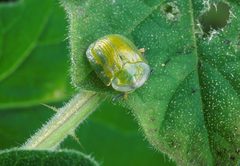
beetles are approximately 6 mm long and 4–5 mm wide. Young adults are green, turning yellow with age. During , adults become pale brown. The is somewhat transparent; during reproductive season, internal sex organs are visible through the —white in females and orange in males. Larvae are light green and covered in spines; older larvae typically carry fecal shields. Pupae are flattened, pale green, and attach to the undersides of leaves.
Habitat
In its native range, occurs in supporting tropical soda apple (Solanum viarum) in Argentina, Brazil, and Paraguay. In the introduced range (Florida), established in pastures and conservation areas where the plant occurs. performance differs between open and shaded habitats, with differential establishment success. Cold temperatures prevent establishment farther north in the United States.
Distribution
Native to South America: Argentina, Brazil, and Paraguay. Introduced and established in Florida, USA since 2003. Released in many areas of Florida but establishment limited by cold sensitivity; cannot develop where freezing temperatures occur.
Seasonality
In Florida, enter from December through March, remaining in leaf litter. Adults emerge in March or April to feed and mate. Seven to eight occur annually. Activity ceases with onset of cold weather; northern establishment limited by inability to survive freezing temperatures.
Diet
Specialized herbivore feeding exclusively on tropical soda apple (Solanum viarum). feed on foliage, creating holes in leaves. Larvae feed voraciously on the upper third of the plant. The is highly -specific: laboratory studies showed it can only complete its on tropical soda apple, with only slight feeding on a few other Solanum and no survival to adulthood on native US Solanum species or crop plants.
Host Associations
- Solanum viarum - primary (obligate)Tropical soda apple; sole supporting complete development in both native and introduced ranges
- Solanum palinacanthum - secondary Only other known natural in South America; rare compared to S. viarum
Life Cycle
Females lay single (1–2 mm including papery casing) on leaves of the plant, producing approximately 300 eggs over a lifespan of 3–4 months. Eggs hatch in 5–6 days. Larvae progress through five instars over 16–18 days, feeding voraciously and carrying fecal shields as older larvae. lasts approximately one week, with pupae attached to leaf undersides. Total development time from egg to is temperature-dependent. Adults undergo reproductive during winter months (December–March in Florida), becoming and pale brown in color while hidden in leaf litter.
Behavior
and larvae feed openly on foliage, causing visible damage. Larvae are gregarious and can defoliate plants when natural enemies are absent. Adults 'clamp' down against leaves when disturbed, a typical tortoise beetle defense. The shows strong fidelity to its plant, with limited away from tropical soda apple stands. Performance and establishment differ between open and shaded .
Ecological Role
herbivore and agent. In its native range, a natural herbivore of tropical soda apple. In Florida, functions as a agent, reducing growth, fruit production, and of the weed through defoliation. Feeding damage facilitates entry and stresses plants. The supports local as prey for various and .
Human Relevance
Released as a agent against tropical soda apple, an weed costing ranchers millions of dollars in reduced cattle and control costs. Over 250,000 beetles were reared and released in Florida from 2003 to 2011. The program is considered successful: beetles have established in many areas, causing significant defoliation and reduction in weed without attacking non-target plants. The ' narrow specificity makes it a model for safe biocontrol introduction.
Similar Taxa
- Gratiana pallidulaAnother North American tortoise beetle in the same , but associated with silverleaf nightshade (Solanum elaeagnifolium) rather than tropical soda apple; have paler coloration and different fidelity
- Other Cassidinae tortoise beetlesShare rounded body form and leaf-clamping , but distinguished by association, coloration patterns, and geographic distribution; G. boliviana is the only tortoise beetle released for tropical soda apple biocontrol
Sources and further reading
- BugGuide
- Wikipedia
- GBIF taxonomy match
- iNaturalist taxon
- Catalogue of Life
- Buprestidae | Beetles In The Bush | Page 9
- ambush bugs | Beetles In The Bush
- spiders | Beetles In The Bush | Page 4
- jewel beetles | Beetles In The Bush | Page 8
- Classical Biological Control of Tropical Soda Apple with Gratiana boliviana
- Tropical Soda Apple Leaf Beetle, Gratiana boliviana Spaeth (Insecta: Coleoptera: Chrysomelidae: Cassidinae)
- Biology of Gratiana boliviana, the First Biocontrol Agent Released to Control Tropical Soda Apple in the USA
- Biology of Gratiana boliviana, the First Biocontrol Agent Released to Control Tropical Soda Apple in the USA
- Arthropod Community Associated with Tropical Soda Apple and Natural Enemies ofGratiana boliviana(Coleoptera: Chrysomelidae) in Florida
- Differential Performance of Tropical Soda Apple and Its Biological Control Agent Gratiana boliviana (Coleoptera: Chrysomelidae) in Open and Shaded Habitats
- Gratiana boliviana, a potential biocontrol agent of Solanum viarum: Quarantine host-specificity testing in Florida and field surveys in South America
- OPEN-FIELD HOST SPECIFICITY TEST OF GRATIANA BOLIVIANA (COLEOPTERA: CHRYSOMELIDAE), A BIOLOGICAL CONTROL AGENT OF TROPICAL SODA APPLE (SOLANACEAE) IN THE UNITED STATES
- Temperature-dependent development, cold tolerance, and potential distribution ofGratiana boliviana(Coleoptera: Chrysomelidae), a biological control agent of tropical soda apple,Solanum viarum(Solanaceae)