
Megacerus
Fåhraeus in Schönherr, 1839
Large-horned Bruchids
Species Guides
7- Megacerus coryphae(Coastal Red Bruchid)
- Megacerus cubiculus(Cubical Bruchid)
- Megacerus discoidus (Say, 1824)(red megacerus)
- Megacerus impiger
- Megacerus leucospilus(aggie bruchid)
- Megacerus maculiventris
- Megacerus schaefferianus
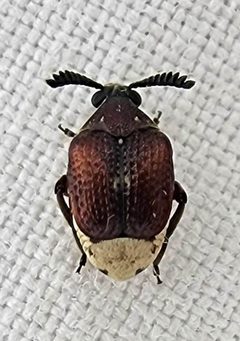
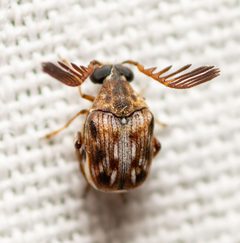
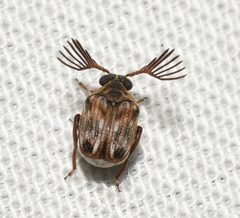
Megacerus is a of seed beetles in the Chrysomelidae, Bruchinae, commonly known as large-horned bruchids. The genus contains approximately nine described in North America. Species in this genus are seed , with larvae developing endophytically within seeds of plants, primarily in the family Convolvulaceae. are characterized by prominent genal or frontal horns, particularly in males. The genus has been studied for its potential use in of weedy bindweeds.
Pronunciation
How to pronounce Megacerus: /ˈmɛgəsərəs/
These audio files are automatically generated. While they are not always 100% accurate, they are a good starting point.
Identification
Megacerus are distinguished from other bruchine by the presence of large, often curved horns on the , especially pronounced in males. These horns arise from the genae or and are a diagnostic feature of the genus. Species-level identification requires examination of male genitalia and horn ; female identification is more difficult due to reduced or absent horns. The genus can be separated from similar bruchines by the combination of large body size, horn development, and association with Convolvulaceae plants.
Images
Habitat
in this are associated with supporting their Convolvulaceae plants, including hedgerows, fence rows, disturbed areas, and agricultural edges. Megacerus discoidus has been documented in southwestern Virginia in areas with dense stands of hedge bindweed. Host plant availability is the primary determinant of local habitat suitability.
Distribution
The occurs in North America with approximately nine described . Documented distribution includes the United States (Virginia, Vermont, Colorado) and Mexico. Specific distribution varies by species; Megacerus discoidus is recorded from southwestern Virginia with potential for wider range given plant distribution. Mexican species include Megacerus centralis and others with documented regional .
Diet
Larvae feed endophytically on seeds of Convolvulaceae. Megacerus discoidus specializes on hedge bindweed (Calystegia sepium). Other show varying degrees of specificity within the morning glory . feeding habits are poorly documented; adults may feed on pollen or not feed substantially.
Host Associations
- Calystegia sepium - primary hedge bindweed; confirmed for M. discoidus
- Convolvulaceae - -level associationmultiple Megacerus associated with various in this
Life Cycle
are laid on the external surface of developing seed pods. Larvae bore through pod walls and feed internally within a single seed, completing all larval instars endophytically. occurs within the seed. emerge by chewing circular exit holes. Megacerus discoidus is with a single per year, as larvae within seeds. Developmental timing is synchronized with plant seed maturation.
Behavior
Larvae are obligate seed endophytes, completing their entire development within a single seed without changing seeds. Females exhibit oviposition preferences that may influence patterns of host use across available plant . emerge by chewing distinct circular exit holes in seed coats. No beyond adult have been documented.
Ecological Role
Primary seed of Convolvulaceae, particularly hedge bindweed. By destroying seeds, these beetles reduce plant reproductive success and may limit spread. Megacerus discoidus has been investigated as a potential agent for hedge bindweed, a weedy problematic in agricultural and horticultural settings.
Human Relevance
Investigated for of weedy morning glories and bindweeds, particularly Calystegia sepium. No significant direct economic impact as crop pests; specificity on non-crop Convolvulaceae limits agricultural damage. Not known to be of medical or veterinary importance.
Similar Taxa
- Other Bruchinae generaLack prominent cephalic horns; Megacerus distinguished by male horn development and typically larger body size
- AcanthoscelidesSimilar seed beetle but lacks horns, has different associations (often Fabaceae), and generally smaller body size
- CallosobruchusStored product pests lacking horns, associated with legume seeds rather than Convolvulaceae
More Details
Sexual dimorphism
Males possess well-developed cephalic horns; females typically have reduced or absent horns. Female body weight exceeds male body weight within , a pattern linked to differential reproductive allocation.
Host seed size relationship
Across Megacerus , body weight with seed weight, with smaller species associated with smaller-seeded hosts and larger species with larger seeds. This pattern suggests coevolutionary specialization and oviposition preference mechanisms.
Taxonomic note
The has been classified in Bruchidae in older literature, but current places Bruchinae as a within Chrysomelidae. The 'large-horned bruchids' reflects this historical classification.
Sources and further reading
- BugGuide
- Wikipedia
- GBIF taxonomy match
- iNaturalist taxon
- NCBI Taxonomy
- Catalogue of Life
- A New Species of the Seed Beetle Genus Megacerus Fåhraeus, 1839 (Coleoptera: Bruchidae) and Redescription of Megacerus centralis (Pic), with a Key to the Mexican Species and New Host and Distribution Records
- Life History of Megacerus discoidus (Coleoptera: Bruchidae), a Seedfeeder of Hedge Bindweed, in Southwestern Virginia
- Host Specificity of Megacerus discoidus (Coleoptera: Bruchidae) and Its Impact on Hedge Bindweed, Calystegia sepium
- Local Host Adaptation and Use of a Novel Host in the Seed Beetle Megacerus eulophus
- New Host Record for Megacerus flabelliger Fåhraeus (Coleoptera: Chrysomelidae: Bruchinae) and Some Notes about its Life History
- Correction: Local Host Adaptation and Use of a Novel Host in the Seed Beetle Megacerus eulophus
- Relationship between the weights of seed beetles of the genus Megacerus Fåhraeus, 1839 (Coleoptera: Chrysomelidae: Bruchinae) and their host seeds of the family Convolvulaceae