
Megacerus discoidus (Say, 1824)
Say, 1824
red megacerus
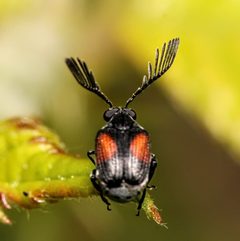
Megacerus discoidus is a seed-feeding bruchine in the Chrysomelidae. It is a of hedge bindweed (Calystegia sepium) seeds, with larvae completing their entire development within individual seeds. The has been studied for its potential use in of this weedy vine. It occurs in North America and Central America.
Pronunciation
How to pronounce Megacerus discoidus (Say, 1824): /mɛˈɡæsərəs dɪsˈkɔɪdəs/
These audio files are automatically generated. While they are not always 100% accurate, they are a good starting point.
Identification
Distinguished from other Megacerus by its association with hedge bindweed seeds; of the Megacerus are generally characterized by enlarged hind . Specific diagnostic features for M. discoidus require examination of genitalia or other detailed morphological characters not available in the provided sources.
Images
Habitat
Associated with hedge bindweed (Calystegia sepium) growing in open, disturbed areas; observed in southwestern Virginia in agricultural and semi-natural settings where the vine occurs.
Distribution
North America and Central America; documented in southwestern Virginia, Alberta (Canada), and Middle America.
Diet
Seeds of hedge bindweed (Calystegia sepium).
Host Associations
- Calystegia sepium - obligate larval Complete larval development occurs within seeds of this vine; host specificity studies indicate narrow host range.
Life Cycle
are deposited on or into hedge bindweed seed pods. Larvae feed and develop entirely within a single seed, consuming the endosperm. occurs within the seed, and emerge by chewing an exit hole. Voltinism and stage not specified in available sources.
Behavior
Obligate seed-feeding; larvae are confined to individual seeds throughout development. have been observed to emerge from seeds.
Ecological Role
Seed that reduces viable seed production of hedge bindweed; has been investigated as a potential agent for management of this weedy .
Human Relevance
Studied as a candidate agent for hedge bindweed, a problematic agricultural and ornamental weed. No other documented economic or cultural significance.
Similar Taxa
- Other Megacerus speciesShare enlarged hind and general bruchine ; distinguished by plant association and presumably by genitalic characters.
- Other Bruchinae (seed beetles)Similar larval habit of developing within legume or convolvulaceous seeds; M. discoidus specifically associated with Calystegia sepium rather than Fabaceae .
More Details
Taxonomic Note
Bruchinae is sometimes treated as Bruchidae; current classification places it as within Chrysomelidae. The 'pea or bean weevil' is misleading as this feeds on Convolvulaceae, not Fabaceae.
Research Limitations
Detailed information including longevity, mating , oviposition patterns, and voltinism requires access to full primary literature not available in the provided abstracts.