
Prionus spinipennis
Hovore & Turnbow, 1984
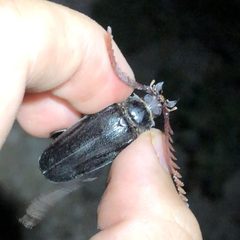
Prionus spinipennis is a large long-horned beetle (Cerambycidae: Prioninae) to sand dune of southeastern New Mexico and western Texas. It is one of two Prionus specialized to this , with P. arenarius occupying spring and early summer, while P. spinipennis occurs in late summer and fall. Males are attracted to prionic acid lures, a synthetic analog of female . The species was described by Hovore & Turnbow in 1984.
Pronunciation
How to pronounce Prionus spinipennis: //ˈpraɪənəs ˌspɪnɪˈpɛnɪs//
These audio files are automatically generated. While they are not always 100% accurate, they are a good starting point.
Identification
Prionus spinipennis can be distinguished from its sympatric P. arenarius by seasonal timing (late summer/fall vs. spring/early summer) and subtle morphological differences. As with other Prionus , males have highly elongated, serrate that can exceed body length, while females have shorter, less elaborate antennae. The specific epithet 'spinipennis' refers to spiny characteristics of the or legs. Accurate identification requires examination of genitalia or comparison with .
Images
Habitat
Strictly associated with sand dune , specifically the shinnery oak (Quercus havardii)-dominated sandhill shrubland and active dune fields of southeastern New Mexico and western Texas. The is a sand dune , adapted to this specialized and geographically restricted environment.
Distribution
to sand dune systems of southeastern New Mexico (Chaves County, Roosevelt County) and adjacent western Texas. Documented from Mescalero Sands Recreation Area in New Mexico and similar sand dune localities in the region. The range is entirely contained within the Chihuahuan Desert ecoregion.
Seasonality
are active in late summer and fall, with peak activity from August through October. This seasonal pattern contrasts with P. arenarius, which is active in spring and early summer (May–June). The temporal separation likely reduces between these ecologically similar, sympatric .
Life Cycle
Larvae are presumed to develop in roots of sand dune vegetation, as is typical for Prionus , though specific plants have not been documented. The likely spans multiple years, with emerging after summer rains trigger final maturation.
Behavior
Males are and strongly attracted to prionic acid lures, which mimic female . They walk rapidly across sand surfaces when searching for females. Females are flightless and release to attract males. Males may also be attracted to lights. Activity occurs primarily at night, with seeking mates during the brief adult period.
Ecological Role
As a large root-boring , larvae likely contribute to nutrient cycling in sand dune through their tunneling activities. may serve as prey for including birds, mammals, and arthropods. The represents a component of the specialized sand dune fauna of the Chihuahuan Desert.
Human Relevance
Similar Taxa
- Prionus arenariusSympatric congeneric occupying the same sand dune but separated by season—P. arenarius is active spring through early summer, while P. spinipennis occurs late summer through fall. Morphologically similar and requiring careful examination for definitive identification.
- Prionus californicusAnother large western Prionus , but occurring in juniper/oak/pinyon woodland rather than sand dunes, with broader distribution across western North America and different seasonal timing.
- Prionus heroicusLarge southwestern Prionus attracted to prionic acid lures, but associated with oak/juniper woodland at higher elevations rather than sand dunes, and with different geographic distribution.
More Details
Conservation status
Prionus spinipennis has not been formally assessed for conservation status, but its restricted range and specialized sand dune make it potentially vulnerable to habitat loss from sand mining, oil and gas development, and dune stabilization efforts. The is known from relatively few documented occurrences.
Research significance
The contributes to understanding of Prionus , as males respond to prionic acid lures. The seasonal partitioning between P. spinipennis and P. arenarius provides a model system for studying temporal separation in closely related, sympatric species.