
Ulochaetes leoninus
LeConte, 1854
Lion Beetle
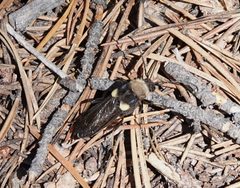
Ulochaetes leoninus, commonly known as the lion beetle, is a of long-horned beetle in the Cerambycidae. It is native to North America, with records from the United States, Canada, and Mexico. The species is notable for its -like appearance, which serves as a form of protective mimicry.
Pronunciation
How to pronounce Ulochaetes leoninus: //ˌjuːloʊˈkeɪtiːz liːəˈnaɪnəs//
These audio files are automatically generated. While they are not always 100% accurate, they are a good starting point.
Identification
This is a convincing mimic, with a body shape and coloration that can cause initial confusion with Hymenoptera. The has been described as having a wasp-like appearance that may startle collectors unfamiliar with the species. It can be distinguished from actual wasps by beetle characteristics including hardened forewings () and the typical cerambycid structure. Within Cerambycidae, it belongs to the Necydalinae, which is characterized by relatively short elytra that expose several abdominal segments.
Images
Distribution
North America. Documented from the United States, Canada (British Columbia), and Mexico.
Behavior
have been observed in and can be captured by hand. The -mimicking appearance appears to be a defensive , though specific behavioral details regarding how this mimicry functions in avoidance have not been documented in the provided sources.
Human Relevance
The is known among entomologists and collectors for its striking -mimicry, which can cause initial confusion or surprise when encountered in the field. One collector reported being initially unable to handle the first specimen encountered by hand despite knowing its identity, due to its convincing wasp-like appearance. The species is represented in entomological collections and has been featured in discussions of curatorial technique and specimen identification challenges.
Similar Taxa
- Vespidae (wasps)Ulochaetes leoninus is a convincing mimic in general body form and coloration, which can lead to misidentification. It can be distinguished by -specific traits: hardened (rather than membranous wings), beetle structure, and the exposed abdominal segments typical of Necydalinae.
- Other NecydalinaeShares the characteristic of short exposing abdominal segments. Specific distinguishing features from congeneric or related within Necydalinae are not documented in available sources.
More Details
Taxonomic Classification
The is placed in the Necydalinae and tribe Necydalini, a group characterized by relatively short that leave several abdominal segments exposed.