
Metacmaeops
Linsley & Chemsak, 1972
Species Guides
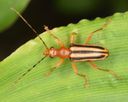
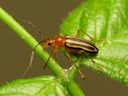
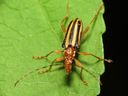
1Metacmaeops is a of longhorn beetles (Cerambycidae) in the Lepturinae, tribe Rhagiini. The genus is , containing only Metacmaeops vittata, a distributed in the eastern United States. Members of this genus are associated with mesic forest and have been documented as flower visitors.
Pronunciation
How to pronounce Metacmaeops: /ˌmɛtəˈkmiːɒps/
These audio files are automatically generated. While they are not always 100% accurate, they are a good starting point.
Identification
As a , Metacmaeops is effectively synonymous with its sole M. vittata in practice. The genus can be distinguished from related Rhagiini genera by the combination of characters defining M. vittata: body with distinct longitudinal vittae (stripes), and overall consistent with the 'flower longhorn' group of Lepturinae.
Images
Habitat
Associated with mesic forests, particularly those containing eastern deciduous tree such as American beech (Fagus grandifolia), tulip poplar (Liriodendron tulipifera), and cucumbertree (Magnolia acuminata). Documented at Trail of Tears State Park in southeastern Missouri, where the unique forest composition supports this and other typically eastern species.
Distribution
Eastern United States. Documented from Missouri (Trail of Tears State Park), Vermont, and other eastern states.
Ecological Role
are flower visitors, suggesting potential role in pollination. The has been found feeding on flowers of wild hydrangea (Hydrangea arborescens) alongside other lepturine beetles.
Human Relevance
Of interest to coleopterists and conservation biologists due to its apparent rarity in collections and association with specialized mesic forest . The has been noted as difficult to detect and potentially overlooked in surveys.
Similar Taxa
- TypocerusBoth belong to Lepturinae and share the 'flower longhorn' , but Metacmaeops is distinguished by its status and specific vittate patterning on M. vittata.
- TrigonarthrisAnother Rhagiini found in similar mesic forest at Trail of Tears State Park; Metacmaeops differs in body form and elytral patterning.
More Details
Taxonomic history
The was established by Linsley & Chemsak in 1972 to accommodate Metacmaeops vittata, which was previously classified elsewhere within the Rhagiini.
Conservation status
Considered rare in collections, though this may reflect detection difficulty rather than true rarity. Its association with specialized mesic forest makes it potentially vulnerable to habitat loss.