
Xestoleptura crassipes
(LeConte, 1857)
flower longhorn
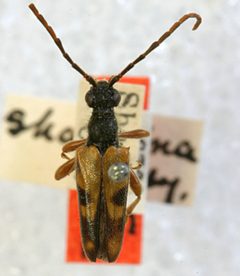
Xestoleptura crassipes is a of flower longhorn beetle in the Cerambycidae. It is native to North America and has been documented across Canada and the United States. The species belongs to the Lepturinae, a group commonly associated with flowers where frequently feed on pollen and nectar.
Pronunciation
How to pronounce Xestoleptura crassipes: /ˌzɛstoʊˈlɛptjʊrə ˈkræsɪˌpiːz/
These audio files are automatically generated. While they are not always 100% accurate, they are a good starting point.
Identification
Xestoleptura crassipes can be distinguished from similar flower longhorn beetles by its relatively robust (thighs), which is reflected in its specific epithet 'crassipes' meaning 'thick-footed'. The Xestoleptura is separated from related genera such as Leptura and Strangalia by subtle differences in antennal structure, pronotal shape, and elytral patterning. Accurate identification to level typically requires examination of genitalic characters and comparison with .
Images
Habitat
are associated with flowering vegetation where they visit blossoms. The occurs in a variety of terrestrial across its range, though specific microhabitat preferences for larvae remain poorly documented. Based on related Lepturinae, larvae likely develop in decaying wood or woody debris.
Distribution
North America, with confirmed records from Canada (Alberta, British Columbia) and the United States. GBIF records indicate presence across western and central regions of the continent.
Behavior
have been observed visiting flowers, a characteristic of the Lepturinae. Flower visitation is presumed to be for feeding on pollen and nectar, though this has not been specifically documented for this .
Ecological Role
As a flower-visiting , likely contribute to pollination of flowering plants. Larval development in decaying wood suggests a role in nutrient cycling and wood decomposition, though this remains inferred from related .
Similar Taxa
- Leptura spp.Similar flower longhorn beetles that share floral visitation and general body form; distinguished by antennal and pronotal characters
- Strangalia spp.Related Lepturinae with overlapping distribution and flower-visiting habits; often more elongate in body form with different elytral patterns
- Xestoleptura spp.Congeneric require careful examination of male genitalia and subtle external morphological differences for accurate separation
More Details
Taxonomic history
Originally described as Leptura crassipes by LeConte in 1857, this was later transferred to the Xestoleptura based on revisions of Lepturinae classification.
Nomenclatural note
The specific epithet 'crassipes' refers to the thickened characteristic of this , a trait useful in field recognition.