
Bellamira scalaris
(Say, 1827)
Ladder-marked Longhorn Beetle
Bellamira scalaris is a longhorn beetle (Cerambycidae) and the sole in its . It belongs to the Lepturinae, a group commonly known as flower longhorns due to their frequent presence on blossoms. The species is native to North America, with records extending from Canada through the United States. are typically found on flowers where they feed on pollen and nectar.

Pronunciation
How to pronounce Bellamira scalaris: /bɛl.ləˈmaɪ.rə skəˈlɛːrɪs/
These audio files are automatically generated. While they are not always 100% accurate, they are a good starting point.
Identification
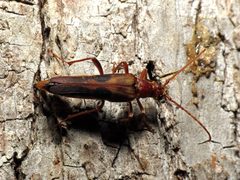
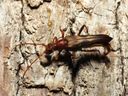
Distinguished from other Lepturinae by the ladder-patterned elytral markings referenced in its specific epithet 'scalaris'. The Bellamira is , so -level identification within the genus is straightforward. May be confused with other flower-visiting cerambycids such as species of Strangalia or Typocerus, but the specific elytral pattern and antennal proportions differ. Confirmation may require examination of genitalia or comparison with reference specimens.
Images
Habitat
Found in wooded and forest-edge where plants and flowering vegetation occur. frequent flowers of various herbaceous and woody plants. Larval habitat presumably involves decaying wood or woody debris, though specific host records are limited.
Distribution
Recorded from North America including Canada (Alberta, Manitoba, New Brunswick) and the United States. Caribbean records also present. The appears to have a broad northern distribution across eastern and central North America.
Seasonality
active during summer months when flowers are in bloom. Specific varies by latitude and local climate conditions.
Diet
feed on pollen and nectar of flowers. Larval diet presumably involves wood or fungal-decayed plant material, typical of Cerambycidae, but specific associations are not well documented.
Life Cycle
Complete with , larval, pupal, and stages. Larval development likely occurs in wood or decaying plant material. Adults emerge in summer and are associated with flowering plants.
Behavior
are and frequently observed on flowers, consistent with Lepturinae . They are capable fliers and move among flowering plants to feed. Specific mating or defensive behaviors are not well documented in available sources.
Ecological Role
serve as while feeding on flowers. Larvae contribute to wood decomposition and nutrient cycling in forest . The is part of the diverse cerambycid fauna that maintains forest health through trophic interactions.
Human Relevance
Occasional visitor to gardens and flowering landscapes. No significant economic impact as a pest; not known to damage structural timber or living trees of commercial value. May be encountered by naturalists and collectors due to its distinctive appearance.
Similar Taxa
- Strangalia spp.Other Lepturinae with similar flower-visiting and elongated bodies, but differ in elytral pattern and antennal proportions
- Typocerus spp.Flower longhorns with banded or spotted , but pattern not ladder-like and body proportions differ
More Details
Taxonomic Notes
Bellamira is a established for this distinctive . The genus placement in Lepturini reflects its morphological affinities with other flower longhorns. The specific epithet 'scalaris' refers to the ladder-like markings on the .
Collection Records
Specimens have been documented through various North American collections, with iNaturalist observations providing recent distributional data. The is not considered rare but may be overlooked due to its similarity to other flower-visiting cerambycids.