
Anastrangalia
Casey, 1924
Species Guides
3- Anastrangalia haldemani
- Anastrangalia laetifica(Dimorphic Flower Longhorn Beetle)
- Anastrangalia sanguinea
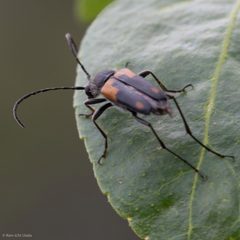
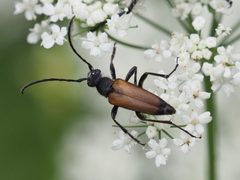
Anastrangalia is a of longhorn beetles in the Cerambycidae, Lepturinae. The genus was established by Casey in 1924 and contains approximately 12 recognized distributed across the Holarctic region. Species in this genus are characterized by their elongated bodies and often exhibit reddish or orange coloration. The genus includes both Eurasian and North American species, with some showing transcontinental distributions.

Pronunciation
How to pronounce Anastrangalia: /ˌænəstrænˈɡeɪliə/
These audio files are automatically generated. While they are not always 100% accurate, they are a good starting point.
Identification
Anastrangalia can be distinguished from related in Lepturini by the combination of: pronotum with distinct lateral or projections; often with contrasting dark and light color patterns; and of moderate length, typically not exceeding body length. The genus is most similar to Leptura and Strangalia, but differs in details of antennal structure and pronotal shape. Species-level identification often requires examination of male genitalia and subtle differences in color pattern and body proportions.
Images
Distribution
Holarctic distribution, with recorded from Europe (including Scandinavia), Asia (Russia, Japan), and North America. GBIF records confirm presence in Denmark, Norway, and Sweden. Individual species show varying ranges: some are restricted to single continents while others have broader trans-Palaearctic distributions.
Seasonality
are typically active during summer months, with peak activity from June to August in temperate regions. This seasonal pattern aligns with the general of Lepturinae, which are often associated with flowering vegetation.
Behavior
have been observed visiting flowers, where they feed on pollen and nectar. This flower-visiting is characteristic of many Lepturinae and may facilitate pollination of plants.
Ecological Role
function as when visiting flowers. Larval stages, like other Cerambycidae, are wood-borers that contribute to decomposition processes in forest , though specific wood associations for most Anastrangalia remain undocumented.
Similar Taxa
- LepturaSimilar body form and flower-visiting , but Leptura generally lack the pronounced pronotal characteristic of Anastrangalia
- StrangaliaOverlaps in color pattern and use; separation requires detailed examination of antennal and pronotal
- BrachytaShared Lepturinae and similar preferences; Brachyta tend to have more robust body proportions and different antennal structure
More Details
Taxonomic History
The was revised by Casey in 1924, consolidating several previously placed in Leptura and related genera. The type species is Anastrangalia sanguinolenta (Linnaeus, 1761), originally described as Leptura sanguinolenta. Species boundaries within the genus remain under study, with some recent taxonomic changes based on molecular and morphological data.
Notable Species
Anastrangalia sanguinolenta is the most widespread European , recognized by its red with black apices. Anastrangalia dubia, described by Scopoli in 1763, is among the earliest described species in the . Anastrangalia haldemani and A. laetifica are representative North American species.