
Neoptychodes trilineatus
(Linnaeus, 1771)
Fig Tree Borer
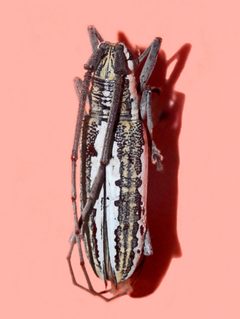
A flat-faced longhorn in the Lamiinae, notable for its variable coloration and distinctive three longitudinal bands. Males are larger than females, reaching up to 35 mm. The "Fig Tree Borer" reflects its association with Ficus .
Pronunciation
How to pronounce Neoptychodes trilineatus: //niːˌɒptɪˈkoʊdiːz ˌtraɪlaɪˈneɪtəs//
These audio files are automatically generated. While they are not always 100% accurate, they are a good starting point.
Identification
Distinguished from similar longhorn beetles by the combination of three pale longitudinal bands on , orange-brown spotting, and flat-faced . Color variation across range requires caution; band pattern remains consistent.
Images
Appearance
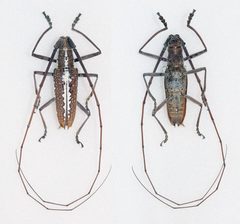
Body length 21–35 mm in males, 19–31 mm in females. Background coloration variable: greyish to dark brown. bear orange-brown spots and three white or yellow longitudinal bands. Body form typical of flat-faced longhorns with elongated .
Habitat
Associated with trees including fig, mulberry, willow, and alder. Specific requirements beyond host presence are not documented.
Distribution
Recorded from Belize, Rica, Cuba, Guatemala, Guyana, Honduras, Nicaragua, Suriname, United States, and Venezuela.
Diet
Larval development occurs in wood of Ficus carica, Morus microphylla, Salix sp., and Alnus sp. feeding habits are not documented.
Host Associations
- Ficus carica - larval main plant
- Morus microphylla - larval main plant
- Salix sp. - larval main plant
- Alnus sp. - larval main plant
Life Cycle
Complete with larval boring in wood. Specific developmental timing and details are not documented.
Ecological Role
Wood-boring larva in living or dead trees; contributes to nutrient cycling through wood decomposition.
Human Relevance
Potential pest of cultivated fig (Ficus carica). "Fig Tree Borer" suggests economic concern, though damage levels are not quantified in available sources.
Similar Taxa
- Other Neoptychodes speciesShare flat-faced and banded elytral patterns; precise identification requires examination of band configuration and genitalia
- Other Lamiinae with longitudinal bandsMany longhorn beetles exhibit banded ; N. trilineatus distinguished by three-band pattern combined with association and geographic range
More Details
Nomenclatural history
Originally described as Cerambyx trilineatus by Linnaeus in 1771; subsequently transferred to Neoptychodes.
Color variation
Wikipedia notes considerable variation in body coloration across the wide range of this , though the three longitudinal bands remain diagnostic.