
Goes pulcher
(Haldeman, 1847)
Living-hickory Borer
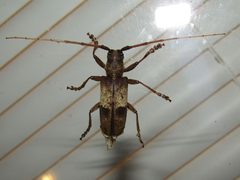
Goes pulcher is a wood-boring in the Cerambycidae, commonly known as the Living-hickory Borer. First described by Haldeman in 1847, it develops in living hickory (Carya) and pecan (Carya illinoinensis) trees. Larvae tunnel beneath the bark, damaging cambium and sapwood. The has a 2-3 year and is distributed across Canada and the United States.

Pronunciation
How to pronounce Goes pulcher: //ɡoʊs ˈpʊlkər//
These audio files are automatically generated. While they are not always 100% accurate, they are a good starting point.
Identification
are cerambycid beetles with typical longhorn . Distinguished from similar Goes by association with living hickory and pecan rather than dead wood; larvae create galleries under bark of living trees, not in seasoned timber. Specific morphological diagnostic features require examination of antennal segments and elytral patterns.
Images
Habitat
Living hickory and pecan trees; larvae develop in cambium and sapwood of trees in forests, orchards, and urban settings where Carya occur.
Distribution
Canada (Ontario, Québec) and the United States; associated with the ranges of hickory (Carya) and pecan (Carya illinoinensis) throughout North America.
Seasonality
emerge in spring and are active during daylight hours.
Diet
Larvae feed on cambium and inner bark of living hickory and pecan trees; do not feed significantly.
Host Associations
- Carya (hickory) - larval primary
- Carya illinoinensis (pecan) - larval commercially important
Life Cycle
2-3 year . Larvae tunnel under bark and into sapwood, creating extensive galleries; they overwinter in these galleries. occurs in spring. emerge in spring, mate, and females deposit in bark crevices of trees.
Behavior
are . Larvae create extensive subcortical galleries that can girdle branches or main stems; heavy may kill young trees or cause significant structural damage to mature trees.
Ecological Role
Primary pest of hickory and pecan. Cambial feeding disrupts tree vascular function, causing economic and ecological damage in natural forests and commercial orchards.
Human Relevance
Significant pest of pecan orchards and hickory timber stands. Heavy reduce nut production in pecan orchards and degrade timber quality; young trees may be killed. Management requires monitoring and targeted applications during .
Similar Taxa
- Other Goes speciesMany Goes develop in dead or dying wood rather than living trees; association is key diagnostic feature
- Other cerambycid borers in hickoryRequire examination of gallery patterns (subcortical vs. deep wood) and condition (living vs. dead) for differentiation
Sources and further reading
- BugGuide
- Wikipedia
- GBIF taxonomy match
- iNaturalist taxon
- NCBI Taxonomy
- Catalogue of Life
- Peacock Jumping Spider Goes Viral! | Bug Squad
- Shapiro Records First-of-the-Year Cabbage White Butterfly: 'Pop Goes the Pieris' | Bug Squad
- Encyrtid Holdings | Entomology Research Museum
- Nota Lepidopterologica goes advanced open access with Pensoft Publishers | Blog
- Stinking Here and There: Invasive Stink Bug Goes From Crops to Homes
- The mini grasshoppers that outlived dinosaurs: the fascinating world of Tetrigidae | Blog
- Biology and Damage of the Hickory Borer, Goes pulcher, in Hickory and Pecan