
Agapanthiini
Genus Guides
2Agapanthiini is a tribe of longhorn beetles within the Lamiinae (Cerambycidae), comprising approximately 90 distributed primarily across the Palearctic, Oriental, and Afrotropical regions. The tribe includes the well-known genus Agapanthia, whose members are often associated with herbaceous plants. Many genera exhibit elongated, cylindrical body forms typical of Lamiinae, though substantial morphological diversity exists across the tribe. Taxonomic revisions continue to clarify generic boundaries, particularly for groups historically defined by superficial similarities in antennal and elytral patterns.

Pronunciation
How to pronounce Agapanthiini: /ˌæɡəˈpænθi.aɪˌnaɪ/
These audio files are automatically generated. While they are not always 100% accurate, they are a good starting point.
Identification
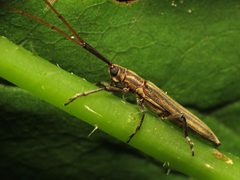
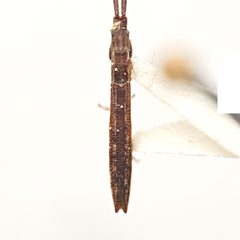
Members of Agapanthiini are distinguished from other Lamiinae tribes primarily by combinations of antennal structure, pronotal shape, and elytral patterns. In some such as Ectinogramma, males possess a diagnostic with an spinous projection longer than the pedicel itself, absent in females. The tribe lacks the strongly laterally compressed pronota characteristic of some related Lamiinae groups. Antennal length varies considerably among genera, from moderately long to distinctly exceeding body length. typically bear patterns of pubescent fasciae or spots, though these are highly variable and not tribe-diagnostic without reference to other characters.
Images
Habitat
associations are documented for few . Ectinogramma have been collected in montane forest at elevations of 245–2000 m in Borneo and Kalimantan. Many Agapanthia species occupy grassland, meadow, and forest edge habitats where their herbaceous plants occur. The tribe as a whole shows no single habitat specialization, reflecting the broad ecological diversification of constituent genera.
Distribution
The tribe has a broad Old World distribution spanning the Palearctic, Oriental, and Afrotropical regions. Documented occurrences include: Europe and temperate Asia (numerous Agapanthia ); Malaysia (Kuala Lumpur, Penang, Sabah/Borneo); Indonesia (Kalimantan, Sumatra); and various localities across Africa and Madagascar. The Ectinogramma is restricted to Sundaland (Borneo, Sumatra, and the Malay Peninsula).
Human Relevance
Some Agapanthia are minor pests of cultivated plants, including asparagus and various ornamental Allium species. The tribe otherwise has limited direct economic impact. Members are occasionally encountered by collectors and in biodiversity surveys of Old World forest and grassland .
Similar Taxa
- SaperdiniOverlaps in general body form and elytral patterns; distinguished by different antennal structure and typically more robust pronotal form.
- PhytoeciiniSimilar elongate body shape and antennal proportions; separation requires examination of male genitalia and detailed tarsal structure.
More Details
Taxonomic Scope
The tribe contains approximately 90 , making it one of the more -rich tribes within Lamiinae. Recent revisions have synonymized several genera established by Breuning in the mid-20th century based on improved understanding of character variation.
Sexual Dimorphism
Antennal has been documented in Ectinogramma and likely occurs in other , with males bearing specialized projections on the . This character has proven useful for determining sex in historical where genitalia were not examined.