
Lagocheirus araneiformis
(Linnaeus, 1767)
Spider Longhorned Beetle, Cassava Borer, Almácigo Borer
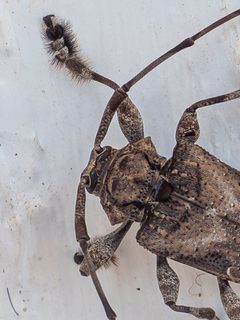
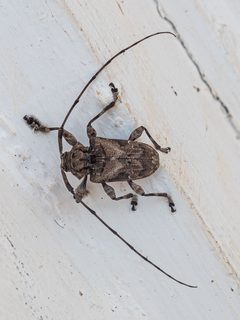
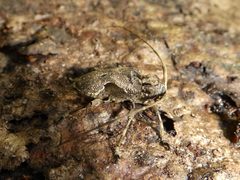
Lagocheirus araneiformis is a longhorn beetle in the Lamiinae, described by Linnaeus in 1767. It reaches 20–28 mm in length with grey-brown coloration. The is widely distributed across the Americas and has been recorded as a pest of cassava and sugarcane. Multiple have been described from Caribbean islands and other regions.
Pronunciation
How to pronounce Lagocheirus araneiformis: /ˌlæɡoʊˈkaɪrəs əˌræniːəˈfɔːrmɪs/
These audio files are automatically generated. While they are not always 100% accurate, they are a good starting point.
Identification
Distinguished from other longhorn beetles by its grey-brown coloration and size range of 20–28 mm. The specific epithet 'araneiformis' (spider-shaped) may refer to body proportions or leg structure. identification requires examination of subtle morphological differences in coloration and pattern.
Images
Appearance
measure 20–28 mm in length. The body is grey-brown in basic coloration. As a member of Lamiinae, the exhibits the elongated body form and long characteristic of longhorn beetles.
Habitat
Associated with agricultural and natural environments where plants occur. Has been collected in areas with cassava and sugarcane .
Distribution
Native to the Americas. Recorded from Mexico, Central America (Belize, Rica, Guatemala, Honduras, Nicaragua, Panama), Caribbean islands (Antigua, Aruba, Bequia, Bonaire, Cayman Islands, Cuba, Curaçao, Dominica, Dominican Republic, Grenada, Guadeloupe, Haiti, Jamaica, Martinique, Mustique, Puerto Rico, St. Barthélemy, St. Croix, St. Eustatius, St. John, St. Lucia, St. Martin, St. Vincent, Tobago, Trinidad, Virgin Islands), and South America (Argentina, Bolivia, Brazil, Colombia, Ecuador, French Guiana, Guyana, Peru, Venezuela). Introduced to Hawaii and Society Islands in the Pacific, and to Florida in the United States.
Diet
Larvae have been observed feeding on cassava (Manihot esculenta) and sugarcane (Saccharum ). The diet has not been specifically documented.
Host Associations
- Manihot esculenta - larval cassava
- Saccharum - larval sugarcane
Ecological Role
As a wood-boring , larvae contribute to nutrient cycling in dead and dying plant material. The has been documented as an agricultural pest, indicating potential economic impact in cultivated systems.
Human Relevance
Considered a pest of cassava and sugarcane, two economically important crops in tropical and subtropical regions. The has been introduced to several Pacific islands and Florida, potentially expanding its agricultural impact.
Similar Taxa
- Other Lagocheirus speciesSame ; differentiation requires examination of antennal segment proportions, body shape, and male genitalia
- Other Lamiinae in AcanthocininiSimilar body form and size range; identification relies on specific coloration patterns and structural details of the pronotum and
More Details
Subspecies
Eight have been described: L. a. araneiformis (nominate), L. a. curacaoensis, L. a. flavolineatus, L. a. fulvescens, L. a. guadeloupensis, L. a. insulorum, L. a. stroheckeri. Geographic variation in island has driven subspecies recognition.
Mite associations
L. a. stroheckeri has been documented with phoretic mites inhabiting pronotal pits, with suggestions that these structures may be adapted for mite transport (acarinaria-like function).