
Dendrobias mandibularis mandibularis
Dupont, 1834
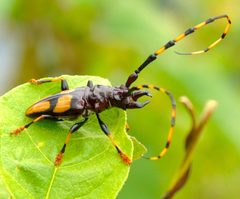
A large cerambycid beetle in the tribe Trachyderini, notable for males possessing extraordinarily enlarged used in combat. The nominate occurs in the southwestern United States and Mexico. are and frequently encountered on flowering vegetation, particularly Baccharis sarothroides. The has been subject to taxonomic confusion, with some authorities placing it in the Trachyderes.
Pronunciation
How to pronounce Dendrobias mandibularis mandibularis: //dɛnˈdroʊbiəs ˌmændɪˈbjuːlərɪs//
These audio files are automatically generated. While they are not always 100% accurate, they are a good starting point.
Identification
Distinguished from and similar Trachyderes by the extreme mandibular development in males, which project forward and are used in male-male combat. Females lack these enlarged . The species is large-bodied with typical trachyderine coloration. Separation from Trachyderes mandibularis (sensu lato) requires examination of genitalic and other subtle morphological characters; the two are frequently confused in literature and collections.
Images
Habitat
Desert thorn-scrub and grassland with abundant Baccharis sarothroides (desert broom). Found in areas with recent rainfall and green vegetation growth. Associated with washes, roadsides, and disturbed areas where plants flourish.
Distribution
Southwestern United States (Arizona, New Mexico, Texas) and Mexico. Records from southeastern Arizona (Santa Rita Mountains, Huachuca Mountains), vicinity of Naco and Tombstone, and western Texas.
Seasonality
Active during summer monsoon season (July–August) when plants are in bloom and vegetation is green. have been collected in late July and early August.
Host Associations
- Baccharis sarothroides - feeding site frequently found on flowering plants, particularly after rainfall
Behavior
Males use enlarged in combat with other males. are and readily observed on vegetation. Individuals are alert and can be difficult to approach closely.
Similar Taxa
- Trachyderes mandibularisTaxonomically confused; D. mandibularis has been treated as a synonym or valid depending on authority. External extremely similar, requiring dissection for definitive identification.
- Dendrobias mandibularis arizonensisOther in the complex, potentially overlapping in range and requiring careful examination for separation.
- Stenaspis solitariaSympatric large cerambycid found on similar plants; distinguished by different antennal structure and lack of enlarged in males.