
Oeme
Newman, 1840
Species Guides
2- Oeme costata
- Oeme rigida(Rigid Oeme)
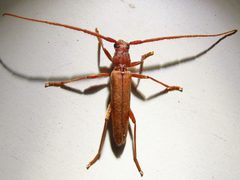
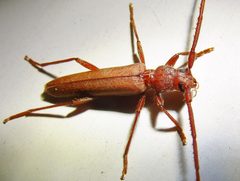
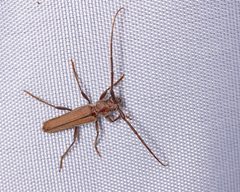
Oeme is a of longhorn beetles (Cerambycidae) established by Newman in 1840. The genus contains two recognized : Oeme costata LeConte, 1873 and Oeme rigida (Say, 1826). Members of this genus are associated with coniferous trees, particularly pinyon pines. Oeme costata has been documented from single-leaf pinyon pine (Pinus monophylla) in the Spring Mountains of Nevada, where are active nocturnally on tree trunks. The genus belongs to the tribe Oemini within the Cerambycinae.
Pronunciation
How to pronounce Oeme: /ˈiːmɛ/
These audio files are automatically generated. While they are not always 100% accurate, they are a good starting point.
Images
Habitat
Coniferous woodland and forest; associated with pinyon pine (Pinus monophylla) and likely other conifer .
Distribution
Western North America. Oeme costata recorded from Nevada (Spring Mountains/Kyle Canyon area). Oeme rigida distribution not specified in available sources but described from Say's original work (1826) likely from eastern or central North America.
Seasonality
activity observed in September in Nevada.
Host Associations
- Pinus monophylla - occurrence on trunk; likely larval single-leaf pinyon pine in Spring Mountains, Nevada
Behavior
are and have been observed on tree trunks at night.
Similar Taxa
Sources and further reading
- BugGuide
- Wikipedia
- GBIF taxonomy match
- iNaturalist taxon
- NCBI Taxonomy
- Catalogue of Life
- Oecanthidae | Beetles In The Bush
- Chrysididae | Beetles In The Bush
- Biogeography, ecology and conservation ofErebia oeme(Hübner) in the Carpathians (Lepidoptera: Nymphalidae: Satyrinae)
- Phylogeographic analyses reveal recent dispersal and multiple Wolbachia infections of the bright-eyed ringlet Erebia oeme within the European mountain systems