
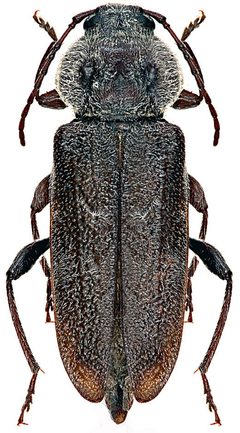
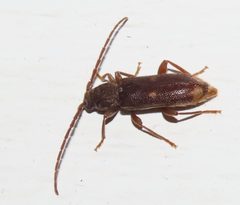
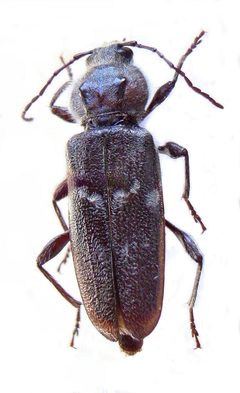
Hylotrupes bajulus
(Linnaeus, 1758)
House Longhorn Beetle, Old House Borer, European House Borer
is a woodboring and the sole in its . Native to Europe, it has spread globally through timber trade to become practically . It is a significant pest of structural timber, particularly dry coniferous sapwood. Sexually mature females produce a species-specific that attracts males from short distances.
Pronunciation
How to pronounce Hylotrupes bajulus: //haɪloʊˈtruːpiːz bəˈdʒuːləs//
These audio files are automatically generated. While they are not always 100% accurate, they are a good starting point.
Images
Habitat
Dry coniferous sapwood; structural timber in buildings. Associated with timber and wood products.
Distribution
Native to Europe; introduced and established in Southern Africa, Asia, the Americas, Australia, New Zealand, and Mediterranean regions. Specific records from Albania, Austria, Belarus, Belgium, Bosnia-Hercegovina, Bulgaria, Croatia, Cyprus, Czech Republic, Denmark, Estonia, Finland, France, Germany, Greece, Hungary, Iceland, Ireland, Italy, Latvia, Liechtenstein, Lithuania, Luxembourg, Macedonia, Malta, Moldova, Montenegro, Netherlands, Norway, Poland, Portugal, Romania, Russia, Serbia, Slovakia, Slovenia, Spain, Sweden, Switzerland, Ukraine, UK; Armenia, Azerbaijan, China, Georgia, Iran, Iraq, Israel, Lebanon, Syria, Turkey; Algeria, Cote d'Ivoire, Egypt, Libya, Madagascar, Morocco, South Africa, Tunisia, Zimbabwe; USA (Alabama, Connecticut, Delaware, DC, Florida, Georgia, Illinois, Indiana, Louisiana, Maryland, Massachusetts, Minnesota, Missouri, New Jersey, New York, North Carolina, Pennsylvania, Rhode Island, South Carolina, Tennessee, Texas, Virginia), Canada; Argentina, Brazil, Uruguay; Australia (New South Wales, Queensland, Tasmania, Victoria, Western Australia), New Zealand.
Host Associations
- Abies spp. - firs
- Picea spp. - spruces
- Pinus spp. - pines
- Larix spp. - larches
- Pseudotsuga menziesii - Douglas fir
Behavior
Males locate females using a female-produced detected at close range (millimetres). Males exhibit excited searching and occasional copulation attempts with female upon detection. Antennal removal eliminates this response, confirming olfactory mediation. Females scent-mark pine wood substrates through contact, as evidenced by increased male visit frequency and duration.
Human Relevance
Major pest of structural timber and wood products. Infests dry coniferous sapwood in buildings. Spread globally through international timber trade.
More Details
Pheromone Biology
Female is likely produced in the and released with . The is relatively -specific; males of other cerambycid species do not respond. Pheromone detection requires intact and operates over short distances (millimetre range).
Taxonomic Status
Hylotrupes is a within Cerambycidae. The was first described by Linnaeus in 1758.