
Mastogenius crenulatus
Knull, 1934
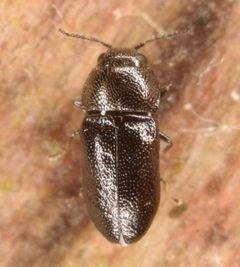
Mastogenius crenulatus is a of metallic wood-boring beetle in the Buprestidae, first described by Knull in 1934. It is one of the smallest buprestids in North America, measuring approximately 2 mm in length. The Mastogenius is characterized by its diminutive size and cryptic dark coloration, making appear as tiny black dots on vegetation.
Pronunciation
How to pronounce Mastogenius crenulatus: //ˌmæstəˈdʒiːniəs ˌkrɛnjʊˈleɪtəs//
These audio files are automatically generated. While they are not always 100% accurate, they are a good starting point.
Identification
Distinguished from other North American buprestids by its extremely small size (~2 mm). Separation from congeneric requires examination of microscopic features such as pronotal and elytral sculpturing; M. crenulatus can be identified by the crenulate (finely notched or scalloped) margins referenced in its specific epithet. are most readily detected by beating oak foliage and examining the collected material carefully.
Images
Habitat
Associated with oak woodlands and forests. are found on oak foliage; larval development occurs within oak tissues.
Distribution
North America; recorded from Ontario, Canada and presumably distributed across eastern and central United States where suitable oak occurs.
Seasonality
active during spring, with peak activity likely coinciding with oak leaf .
Host Associations
- Quercus - larval Larvae develop within oak tissues; specific oak utilized by M. crenulatus not documented
Life Cycle
Larvae are wood-borers within oak, completing development in dead or dying branches. emerge in spring and are found on foliage.
Behavior
are cryptic and easily overlooked due to minute size. They are collected by beating oak branches onto a sheet and examining the dislodged material carefully.
Ecological Role
Larvae contribute to nutrient cycling by breaking down dead oak wood. are likely minor herbivores or on oak foliage, though specific feeding habits unconfirmed.
Human Relevance
No documented economic importance. Of interest to coleopterists due to rarity in collections resulting from small size and cryptic habits.
Similar Taxa
- Brachys speciesAlso small buprestids (~3-5 mm) associated with oaks, but larger than Mastogenius and with distinct pubescent patterns on ; Brachys larvae are leaf-miners rather than wood-borers
- Other Mastogenius speciesRequire microscopic examination of pronotal and elytral sculpturing for separation; M. crenulatus distinguished by crenulate margins
- Taphrocerus speciesSimilar small size and compact form, but associated with sedges (Cyperaceae) rather than oaks; more abbreviated in Taphrocerus
More Details
Collection difficulty
Due to extremely small size, this is rarely encountered by casual observers and is likely underrepresented in collections. Specialized techniques such as beating oak foliage and careful examination of collected material under magnification are required for detection.