
Acmaeodera pubiventris
Horn, 1878
Species Guides
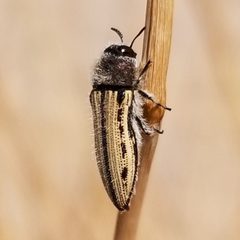
4Acmaeodera pubiventris is a metallic wood-boring beetle in the Buprestidae. The occurs in Central America and North America. Four have been described, with the nominate subspecies and A. p. lanata having documented flower-visiting on Sphaeralcea and Helianthus species. are typically collected during summer months.


Pronunciation
How to pronounce Acmaeodera pubiventris: /ˌæk.miː.əʊˈdɛə.pjuː.bɪˈvɛn.trɪs/
These audio files are automatically generated. While they are not always 100% accurate, they are a good starting point.
Identification
Acmaeodera pubiventris can be distinguished from similar Acmaeodera by examination of specific morphological features, though detailed diagnostic characters require specimen-level study. The A. p. lanata has been observed in the field and can be recognized in part by its geographic range and association with specific floral in the southwestern United States.
Images
Habitat
Found in diverse including pinyon/juniper woodland, Gambel oak woodland, and shortgrass prairie. have been collected from flowers of Sphaeralcea grossulariifolia, Helianthus anomalus, and Eriodictyon angustifolium. The occurs across a range of elevations from lower canyon areas to higher elevation woodlands.
Distribution
Central America and North America. In the United States, documented from Arizona, Utah, Colorado, and surrounding southwestern states. The A. p. lanata occurs in southern Utah and northern Arizona. The nominate subspecies A. p. pubiventris and other subspecies (A. p. panocheae, A. p. yumae) have more restricted distributions.
Seasonality
active during summer months. Field observations indicate peak activity in June and early July, with individuals collected from late June through July in the southwestern United States.
Host Associations
- Sphaeralcea grossulariifolia - flower visitor observed and collected from flowers
- Helianthus anomalus - flower visitor observed and collected from flowers
- Eriodictyon angustifolium - flower visitor lanata collected from flowers
Behavior
are flower visitors, actively moving among blossoms during daylight hours. Individuals have been observed flying between flowering plants and bedding down within spent flowers during evening hours.
Ecological Role
contribute to pollination of flowers through their visitation . The functions as a member of flower-visiting insect in southwestern North American .
Similar Taxa
- Acmaeodera navajoSympatric in southwestern United States; both visit Sphaeralcea flowers and occur in similar pinyon/juniper and dune . A. navajo is smaller and has distinct elytral markings.
- Acmaeodera immaculataFrequently collected together on the same flowers (Helianthus, Sphaeralcea); A. immaculata lacks the maculations or has different patterning compared to A. pubiventris.
- Acmaeodera diffusaOverlaps in and flower-visiting ; A. diffusa is generally smaller with different elytral coloration and pattern.
More Details
Subspecies
Four recognized: Acmaeodera pubiventris lanata Horn, 1880; A. p. panocheae Wescott, 2001; A. p. pubiventris Horn, 1878 (nominate); and A. p. yumae Knull, 1937. Subspecies lanata has been most frequently encountered in recent field studies.
Field Collection Methods
are most effectively collected by visual searching and netting from flowers of known plants. Sweep netting of appropriate flowering vegetation and use of white bowl traps have also proven effective. lanata has been successfully collected using these methods in southern Utah and northern Arizona.